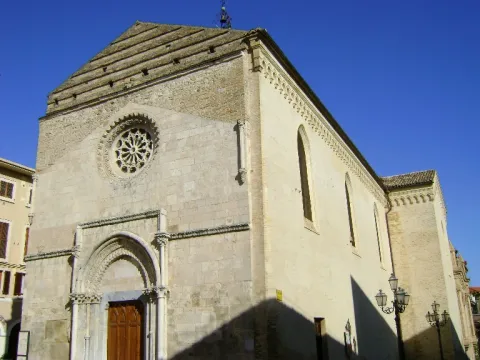
Santa Maria Maggiore is the mother church of Vasto's historic centre, although the town's cathedral is San Giuseppe; it has been a national monument since 1902. The first document recording it dates from 1195: a charter from Emperor Henry VI to Odorisio, Benedictine abbot of San Giovanni in Venere, confirming his possessions. It was the main parish of the Guasto Gisone district, long at odds with San Pietro, the church of the Guasto d'Aimone district; the title of collegiate church, confirmed only in 1734, was taken from it in 1809. Damaged by the Turkish attack of 1 August 1566 and then by the fire of 1645, it was completely rebuilt between 1783 and 1785, when the single-nave church was given a nave and two aisles.
What to see
The façade is small and late Baroque, with a rounded top, and stands beside the bell tower: an imposing tower, the tallest in town, on a four-sided plan, with a medieval-type base decorated with walled-up pointed arches and a very plain Baroque upper part. On the side of the church are white stone reliefs carved in the Middle Ages, with human figures, one of them a peasant, and crosses.
The interior has a nave and two aisles. Along the nave, with its Corinthian columns, niches hold the statues of the twelve Apostles and four prophets. The paintings include an Ecce Homo of the school of Titian, the Mystic Marriage of Saint Catherine attributed to Paolo Veronese, and the Pentecost and the Presentation of the Camauro to Celestine V by Francesco Solimena, of 1727. In the right aisle is the chapel of the Holy Thorn, with the relic given to the church by the d'Avalos, which survived the seventeenth-century fire.
Visiting
The crypt is reached beneath a symmetrical double flight of stairs: it holds the relics of Saint Caesarius dressed as a warrior, donated by Cesare Michelangelo d'Avalos. Opening and Mass times should be checked with the parish.
Our editors' tip
Look for the memorial stone to Bernardino Carnefresca, known as Lupacchino dal Vasto, a composer of madrigals: the church holds the burials of several notable people of Vasto, among them the chronicler Nicola Alfonso Viti and some of the d'Avalos. Also in the right aisle, the chapel of Sant'Antonio abate was built by Tullio Caprioli in 1567.