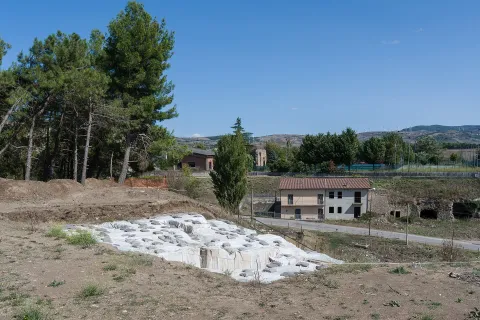
The same basin changed jobs twice. First it was the fountain of a Roman villa, fed by lead fistulae and waterproofed with cocciopesto; then, when a large apsed building went up over the baths, it ended below the floor serving as a cistern. The Torre degli Embrici complex, split between the territories of Atella and Rionero in Vulture, works like that throughout: four building phases cutting into and reusing one another, from the second century BC to final abandonment in the seventh century AD.
What to see
The earliest phase is a bath building: calidarium and tepidarium with their furnace, a cocciopesto floor of which one patch of polychrome mosaic survives in place, walls covered with painted plaster. The dating comes above all from coins, among them a silver denarius placed between 145 and 150 BC and, in the praefurnium area, a plated silver coin of the triumviral period. Between the second and third centuries AD the baths doubled southwards, with a second calidarium and a second tepidarium; hairpins and fragments of glass vessels turned up in these rooms, a sign that women used them.
The third phase turns the picture over. On the disused baths a three-aisled apsed building was raised, perhaps a Christian basilica: 25 metres wide overall, with an apse of almost 12. The old bath furnace became part of a drainage channel running east, where two twin gutters and a few millstones point to a water mill for grinding grain. Beside the basin turned cistern, below floor level, a tile-covered burial came to light with a single grave good: one blue glass bead decorated with white eyes. All of it ends burnt, under a layer of fire and collapse holding pottery and coins of the fourth and fifth centuries; then the fourth phase, a few walls and a small necropolis, before the silence.
Visiting
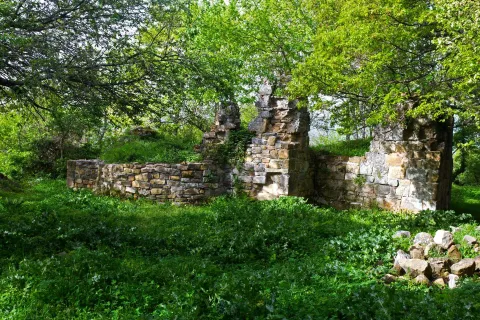
What you visit here is not an archaeological park but an interrupted dig. The decisive campaign was in 2004, led by the American archaeologist Richard Fletcher with researchers from the universities of Alberta, Sydney and Ben Gurion of the Negev; out of it came part of the apse, a coin of Marcus Aurelius Probus, emperor between 276 and 282, and a marble Aphrodite missing head and limbs, now in the archaeological museum of Melfi. A Soprintendenza intervention in 2006 produced modest results; permits followed in 2008 and 2011 and, in 2012, a campaign of cleaning only. None have been granted since.
Our editors' tip
Do the route backwards: Melfi and its archaeological museum first, to see the mutilated Aphrodite, then the ground between Atella and Rionero it came from. And keep in mind a two-thousand-year-old line: Horace, who knew this country, described the Vulture as wild and trackless. The four phases of Torre degli Embrici say exactly the opposite.