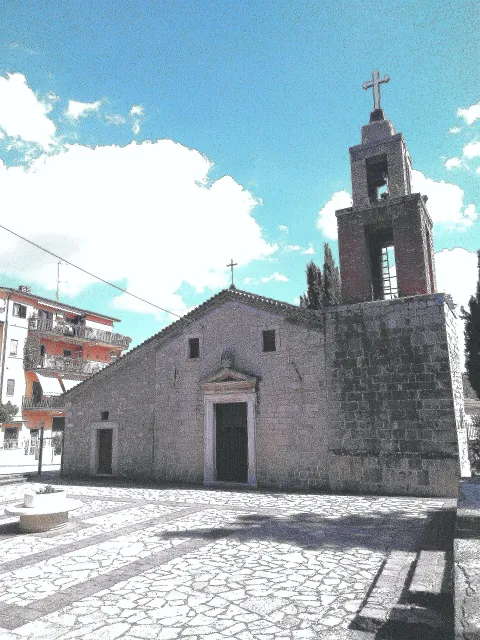
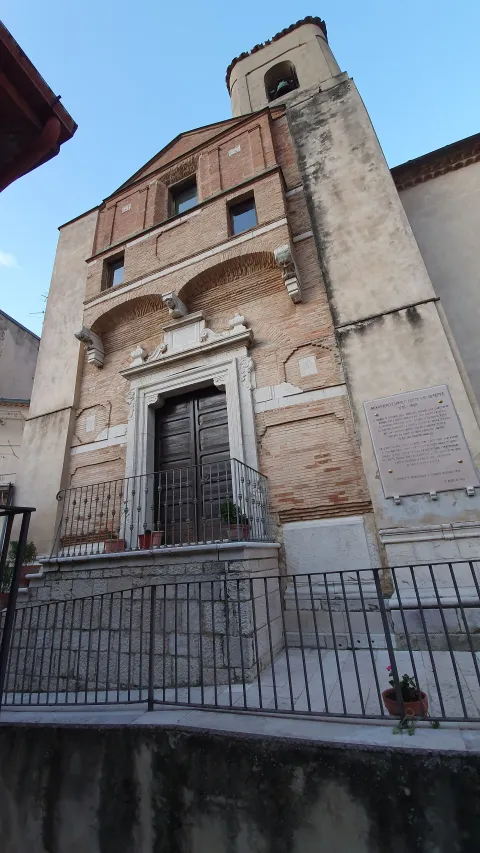
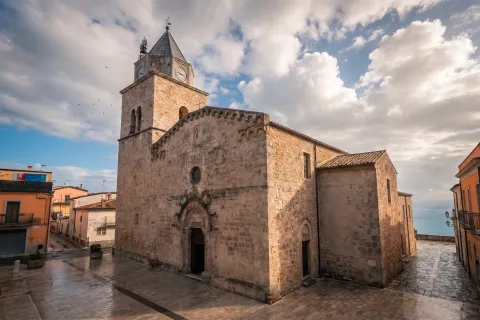
The façade of Ripacandida's mother church carries three clocks, each set inside a rose window, and only one of them still works: the sundial on the right-hand side, which marks the hours in Roman numerals from five in the morning to four in the afternoon. The other two are mechanical and have stopped. The church was born from a bull issued by Monsignor Aquaviva, bishop of Melfi, who in 1540 ordered the two very old parishes of San Nicola and San Bartolomeo to be merged into a single new building, raised where a small church dedicated to Saint Catherine of Alexandria, known as the one «by the castle», already stood. The work was finished only in 1602, under the abbot Lorenzo da Leonibus. The dedication recalls the thirteen barons who left for Palestine on the third crusade under William the Good: on their return, here as in Potenza, churches were built under the name of Santa Maria del Sepolcro.
What to see
The interior runs on three naves, but the first thing to look at is the balustrade dividing the presbytery from the nave, inlaid with polychrome marble. It was made by the archpriest Giambattista Rossi, who worked on it in an artist's studio in Naples; four small columns carry four carved images tied to the Passion, a heart pierced by seven swords, the Virgin at the Sepulchre, Christ rising from the Sepulchre and the baptismal font. Rossi, now a servant of God, has his funeral monument in the chapel of the Sacrament.
The sacristy holds a «Christ in Pity» by Cristiano Danona and a «Saint Bartholomew» by Gaetano Recco. Outside, the tympanum of the Renaissance portal carries a carved Virgin at the Sepulchre; along the flank, with no break in the masonry, leans the eighteenth-century Palazzo Ducale.
Visiting
The church stands on Piazza del Popolo, the highest point of the old town, and you climb to the door up a marble stairway. The 1980 earthquake did not close it and mass went on being said, but the damage grew worse over the years: much of the low wall around the apse came down, all fourteen masonry crosses fell, and the wooden baptismal font was never found again. Restoration proper began in 2007, the church reopened in August 2008 still boxed in by scaffolding, and the outside work was completed only in 2011. In place of the lost font they installed an older one, recovered in 1992 in the cellars of the Monastero di San Giuseppe.
Our editors' tip
Come to the façade in mid-morning, with the sun still low on the right: it is the only moment when the one working clock actually tells you the time. Then walk round to the right flank and find the point where the church and the Palazzo Ducale meet. There is no joint, it is a single wall.