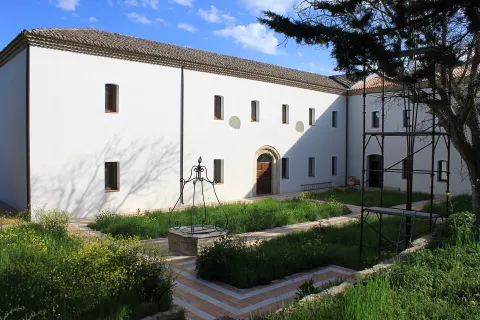
In 1807 a law transferred the monastery to the state, and from that year the local farmers began taking it apart: the stones of its walls ended up in houses and in the low walls around fields and vegetable plots. That is why the abbey of Santa Maria del Sagittario, for centuries the largest landowning power in the Sinni valley, is now little more than a bell tower still standing. Abbot Gregorio De Lauro placed the Benedictine foundation in 1152, born by enlarging a small church that Tancredi Murrino had built in 1061 on land given by Ugo I Chiaromonte and his daughter Alibreda. The name comes from a legend: two hunters tried again and again to hit a hind with their arrows — sagittae — and failed, and on that same hunt they found a wooden image of the Virgin inside a hollow chestnut tree. Damaged by the earthquake of 1184, the abbey passed to the Cistercians in 1200, when abbot Palumbo arrived with twelve monks from Casamari.
What to see
The bell tower is the best preserved piece: it stands at the north-west corner of what was the church, roughly thirteen metres high, with walls almost a metre thick made of split blocks, fired bricks and brick chinking. Two moulded stone string courses are still legible, along with the worked sandstone arches of the surviving openings and the rows of putlog holes left by the scaffolding. At the opposite corner, to the south-east, an octagonal fortification tower survives with its roof intact: a segmental vault built entirely of sandstone slabs. Around them you can pick out part of the masonry entrance, fragments of the refectory and a stretch of the fortified enclosure on the east side.
The rest has to be rebuilt by eye. Every room was arranged around a single square cloister: to the north the single-nave church, with the side chapel dedicated to blessed Giovanni; beside the right transept the chapter house, and next to it the stair that climbed to the monks' common dormitory, which took up the whole upper floor. A plan of 1707 also records a loggia set against the chapter house, from which the monks could see the town of Chiaromonte.
Visiting
The site lies in open countryside in the territory of Chiaromonte, and it is a field of ruins: you walk in the open, with no covered route and no ticket office. Start from the bell tower, the landmark visible from a distance, and use it to line yourself up with the octagonal tower: the line between the two marks the diagonal of the complex. Almost everything the abbey once held is now down in the town: the wooden sarcophagus of blessed Giovanni da Caramola, who died here on 26 August 1339, was carried off in 1808, and the great altar ended up in the collegiate church of San Tommaso Apostolo.
Our editors' tip
Then go down to Chiaromonte, to the mother church of San Giovanni Battista: there you will find the polychrome wooden statue of the Madonna del Sagittario with the Child, which passed from the monastery to San Tommaso in 1807 and stayed there forgotten for decades, until the Bari heritage office took it to the city's picture gallery in 1950. It came back to the town in 2001, after a public subscription. In the right aisle, in a gilded wooden urn, lies the body of blessed Giovanni.