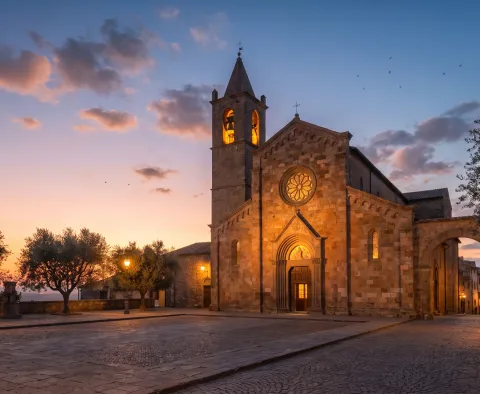
The most remarkable thing about the church of the Carmine is no longer inside the church: the original wooden door panels, carrying images that sum up the medieval way of looking at death, are kept in the Palazzo del Vescovado. The building, dedicated to the Madonna del Carmelo but known to everyone in Melfi as the Carmine, was in any case only one part of a larger complex, the Carmelite convent, which took up a good share of the surrounding buildings.
What to see
What is left of that convent is above all the shape of the nearby blocks. A short walk away, Palazzo Severini goes back to the sixteenth century and was itself a Carmelite convent before passing to Decio Severini, a professor at the universities of Pisa and Rome and a designer of waterworks in Italy, Egypt and Argentina; today it houses an insurance agency. Church and palace, read in sequence, show how much room the order took up in this part of town.
The church is no leftover piece: its confraternity still looks after the Holy Week rites together with that of Sant'Anna, which on Good Friday carries the Madonna Addolorata and the dead Christ in procession, followed by girls dressed in black holding the mysteries of the Passion. It is the chants, mournful and wholly focused on the tragedy of Golgotha, that stay with you longest.
Visiting
To see the door panels you have to change buildings and climb to the Palazzo del Vescovado, home of the Diocesan Museum and its picture gallery: on show are sacred furnishings, silverware and paintings of the seventeenth, eighteenth and nineteenth centuries gathered from the churches of the diocese of Melfi, Rapolla and Venosa. The palace, Norman in its layout and Baroque in appearance after the earthquakes, also holds the episcopal library with several sixteenth-century editions, and has a garden open to visitors.
Our editors' tip
Put the two stops one after the other, the Carmine first and then the museum at the Vescovado: in front of the panels, look for the way death is depicted and compare it with what you have just seen in a church still in use for Holy Week. If you happen to be in Melfi in those days, listen to the confraternity's chants: they are worth the detour on their own.