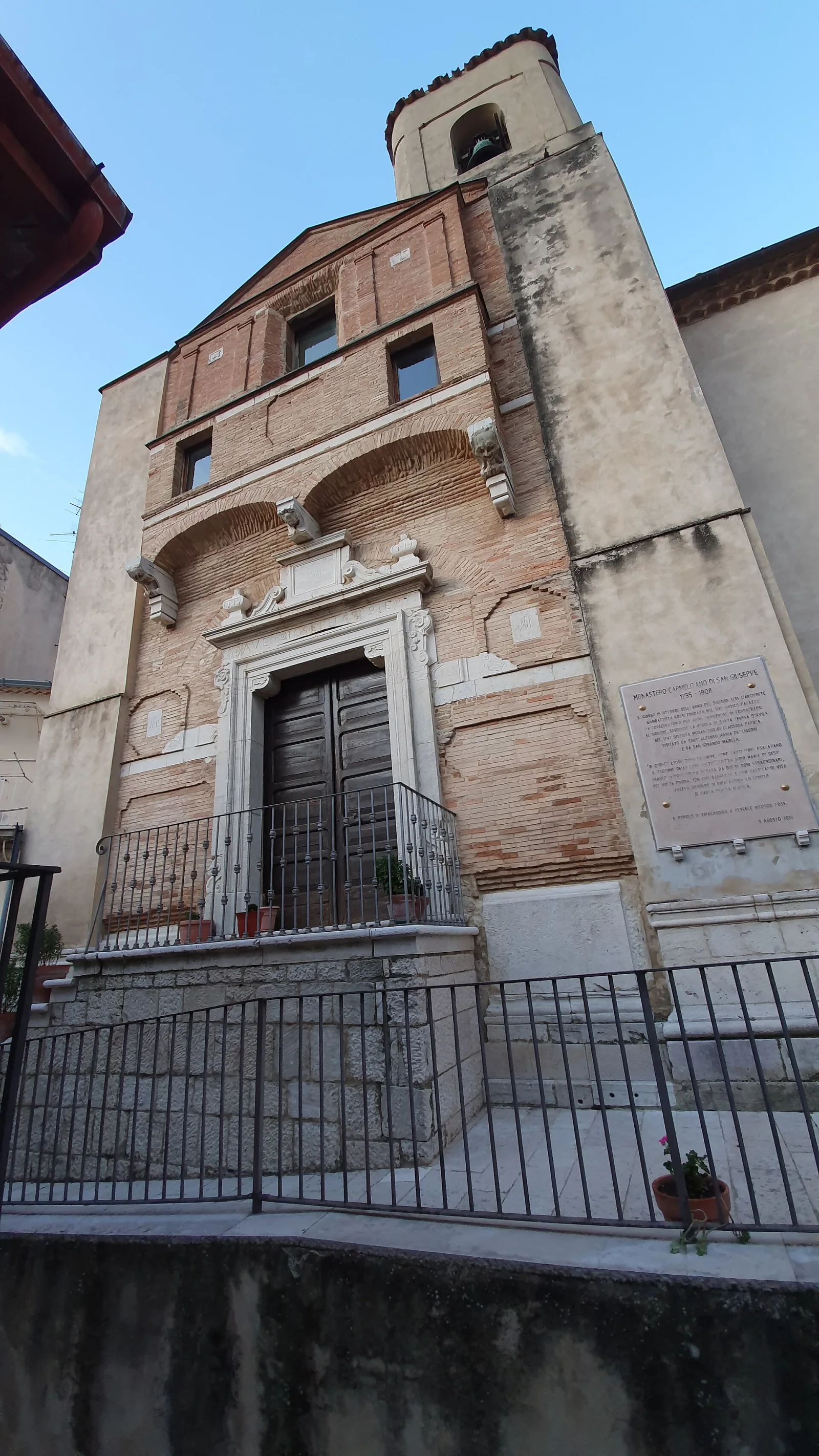
At Ripacandida they call it the nuns' church, and the name says it all: it was attached to an enclosed monastery, and the Discalced Carmelites followed mass from behind the grates, never entering the nave. It is a church designed for a congregation that could not be seen and was not meant to be.
What to see
The monastery was founded in 1735 by the brothers Giovanni and Giambattista Rossi, archpriests, who gave the family palace for the purpose. The front is of brick, with a baroque stone portal and above it the tribune projecting outside on corbels; a tablet recalls a building of the twelfth century, and on the right rises the square-based bell tower.
Inside, on the polychrome marble high altar, is a large altarpiece with the Madonna and Child between saints Teresa and Joseph, by a follower of Solimena, and the funerary monument of Giovanni Rossi. In the sacristy is buried sister Maria Araneo, niece of the founders and prioress, whose body was found during the works that followed the earthquake. In 1751 a famous episode in the life of saint Gerard Majella is said to have happened in this church: the saint's biography recounts that, meeting the prioress through the grate of the parlour, he went into ecstasy and bent the iron spikes as if they were wax.
Visiting
The church is in the centre of Ripacandida, in the province of Potenza; the monastery beside it was suppressed at the beginning of the twentieth century and has been the town hall ever since. You go in for services and on celebration days. Half an hour.
Our editors' tip
Look for the grated openings towards the monastery and stop there. The grate of that story is no longer here: it was given to the museum dedicated to the saint at Materdomini. What remains is the gap where it stood, which is the exact point at which a community of invisible women listened to everything that happened on the other side.