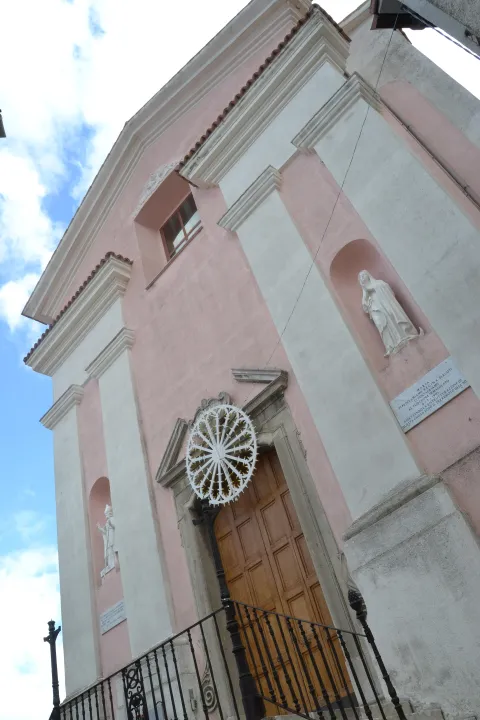
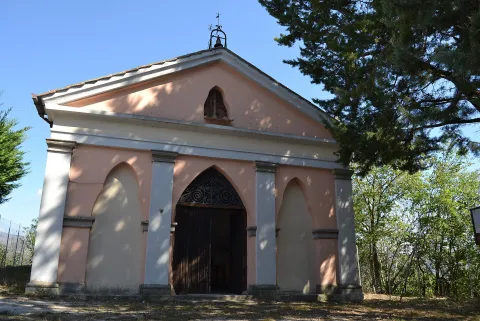
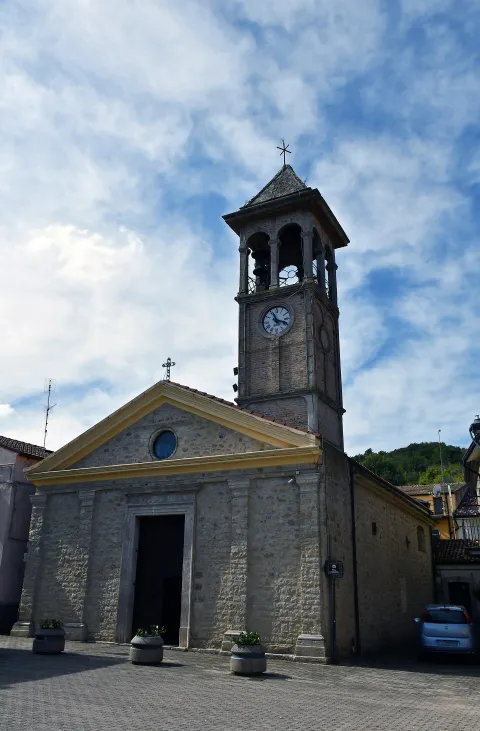
On the first Sunday of September the statue of Saint Roch does not go back to the mother church: it comes up from contrada Spinosa and is carried in here, to the church of San Vito Martire, while a second procession leaves the village to meet it at contrada Marano. That is the day when this building, in substance a chapel, standing on the open space that carries the saint's name, returns to the centre of life in Ruoti.
What to see
The altar is made of Abetina stone, quarried a few kilometres outside the village and recognisable again in the doorways of the old town: lined up together, those altars and doorways say that between 1600 and 1700 Ruoti had capable stonecutters at work. A second, later altar is dedicated to Saint Donatus.
On the vault there is a painting worth the stop: Saint Roch, patron of the village, above a panoramic view of Ruoti, the town itself laid out beneath its protector.
Visiting
The scale is that of a chapel and the visit is short: look up at the vault first, then down to the two altars. The building has been restored several times, always through the devotion of the faithful rather than under any conservation programme, which explains why the old stone sits alongside much more recent work. Chapels in Ruoti keep no museum hours: ask in the village, or time your visit to the patronal feast.
Our editors' tip
Come on 16 August, then come back on the first Sunday of September: they are the two ends of the same feast. In August the statue sets off for contrada Spinosa; in September it returns here, and the two processions, the one climbing from Spinosa and the one led by the mayor, join at contrada Marano. And if you want to see where the altar stone comes from, the Abetina is a few kilometres from the built-up area.