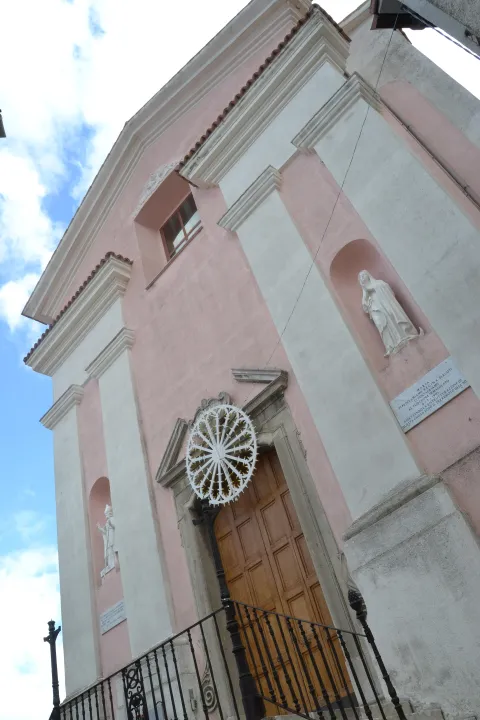
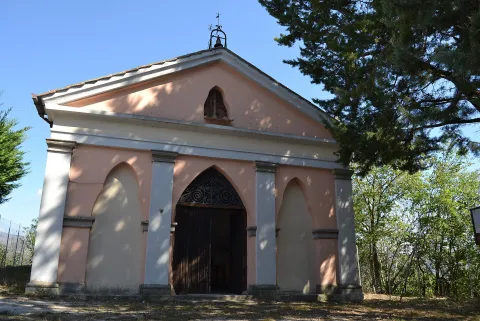
A balance once hung on the wall inside the chapel, two wooden pans and nothing else: whoever wanted to commend himself to Saint Roch stood on one pan and gave the parish priest as much grain as he weighed. The balance is gone, the story is not, and it is the shortest way to understand what this small building means to Baragiano. It is the church of the town's patron saint, probably raised in the sixteenth century, when devotion to Roch of Montpellier spread through southern Italy in the wake of the plague.
What to see
The front holds to a single line: a parapet gable topped by a stone bellcote, with nothing else added. The only colour comes from the ceramic panel set between the doorway and the cornice, which shows the French saint. Beside him stands the dog, holding in its mouth the crust of bread taken from Gottardo Pallastrelli's table; according to the hagiography that bread fed Roch while he lay ill, and the animal enters images of the saint only from the fifteenth and sixteenth centuries onwards.
Inside, the space is plain: a rectangular hall opening into the presbytery through a single central arch. Five wooden statues are kept here.
Visiting
The chapel takes a few minutes and is best begun from outside, standing a few steps back so that gable, bellcote and ceramic can be read together, which is impossible from the doorway. The day the whole town gathers around it is 16 August, the feast of Saint Roch.
Our editors' tip
On the ceramic, hunt for the bread in the dog's mouth before you look at the saint: that detail, not the pilgrim's cloak, tells you which season of the cult the image belongs to. Then picture the wall with the balance hanging on it and the grain measured out person by person.