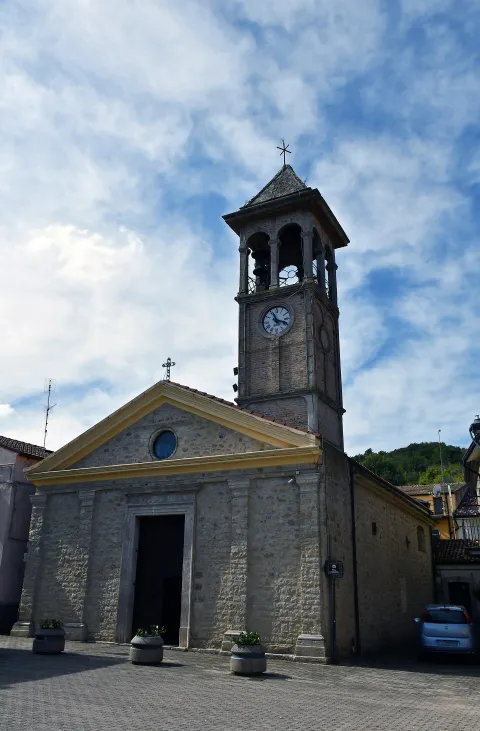
The site foreman, master Antonio Porcello, died in 1802 falling from the dome he was raising. Work on the mother church of Ruoti had been going on for eight years: in 1794 the old church, about half as wide as this one but on the same ground and with the same orientation, was pulled down, and bishop Serrao carried in the first stone of the new one, which swallowed the earlier building. Walls and dome were closed by 1805, the interior by 1810. The design came from the architect Magri, a pupil of Vanvitelli.
What to see
The high altar was not made for Ruoti. Tradition has it that Magri replaced the old one, cut from the marble-like stone of the local Abetina, with an altar brought from the cathedral of Potenza that he had himself reworked: it still carries the mitre and the crozier, a bishop's emblems. Another account makes it a gift from bishop Achille Caracciolo, who rebuilt the cathedral of Potenza and whose mother held the fief of Ruoti; those who have set it beside the altar of the Annunziata chapel in Naples cathedral, a Caracciolo property, have seen the same hand at work. The old altar is still here, on the left, under the statue of Saint Nicholas.
On the walls hang four paintings of the Neapolitan school, author unknown, datable between 1650 and 1700 and given by the Contaldi family: in each the Virgin stands at the centre with saints around her in prayer. The one to the left of the entrance is ringed by fifteen small panels with the mysteries of the rosary. Next to the altar that once belonged to Saint Philomena — the statue has been remade and is now Saint Agnes — stand a wooden statue of Saint Roch of 1700 and a reliquary of some weight.
Visiting
The bell tower is older than the church: it was merely raised higher and finished after 1814, when archpriest Vincenzo Caivano set the example himself and talked the people of Ruoti, of every condition, into carrying stones up from the torrent bed. The earthquake of 16 December 1857 left it in such a state that its height had to be cut back, and it is unsafe once more: you look at it from the ground. Inside, a staircase built in 1971 leads up to the bells and the town clock. And look at the floor to the left of the high altar, in cornu Evangelii: the feudal lady Zenobia Scaglione was buried there, and her remains surfaced during repairs around 1900 before being scattered.
Our editors' tip
Ask about the bells, or go up and see them. The largest is from 1763, older than the church that holds it, and bears the Virgin, Saint Nicholas, Saint Anthony and the Redeemer; on the middle one, cast down at Calvario while the townspeople threw gold and silver objects into the melt, a lizard sits beside Saint Nicholas. The smallest, now cracked, says only the founder's name and the date: Gennaro Danisi, 1887.