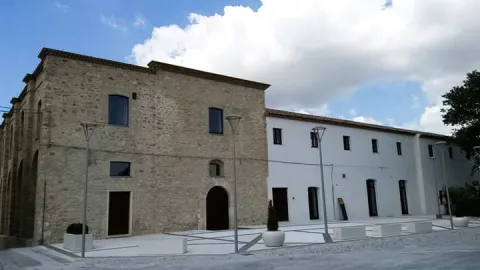
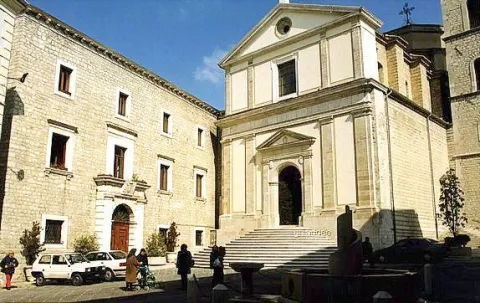
The Museo della civiltà rurale came from neither a bequest nor a dig: the objects and photographs it holds were gathered in the village itself by the local ACLI association, and together they tell the town's story through the things the town used. It was set up close to one of the two gates that once gave access to the old settlement, exactly where the old core ends and the countryside the museum talks about begins.
What to see
The material belongs to a farming community in the Lucanian Apennines: everyday objects and pictures, tracked down among the houses of the village rather than bought elsewhere. What gives the collection its weight is the context around it. In 1881 Vaglio had more than twice as many inhabitants as it has now; by 1931 the count had dropped a long way, partly through emigration to the Americas, and in 1971 the fall had still not stopped. The photographs on the wall are the faces of the crowded village, and the objects are what those who went away left behind.
Look at where you are standing, too. Vaglio's Latin name, Balium, points to a small stronghold of walls, towers and gates set at strategic points: two of those gates can still be made out at opposite ends of the old built-up area, and the museum stands beside one of them.
Visiting
The museum is inside the historic centre and is reached on foot; the collection is run by a local association, so it is worth checking with the town hall that it is open before you drive up. Do not confuse it with Vaglio's other museum, the Museo delle antiche genti di Lucania, which sits in the pine wood outside the village and deals with something quite different: the Lucanian settlement of Serra di Vaglio and the sanctuary at Rossano.
Our editors' tip
On your way out, cross the old built-up area from one gate to the other: they stand at opposite ends, the walk takes a few minutes, and it is the exact measure of the village you have just seen in the photographs. Then, if you have time, go up to the pine wood: the Museo delle antiche genti di Lucania keeps the portrait attributed to Leonardo da Vinci that resurfaced in 2008, while nearly all the excavated finds are in the Museo archeologico nazionale della Basilicata in Potenza.