
Patron saint festival In 291 days
Saint Francis of Paola and Saint Nicodemus the Abbot
📅 Every year, on 4 August
Cirò celebrates together Saint Francis of Paola and Saint Nicodemus the Abbot on 4 August.
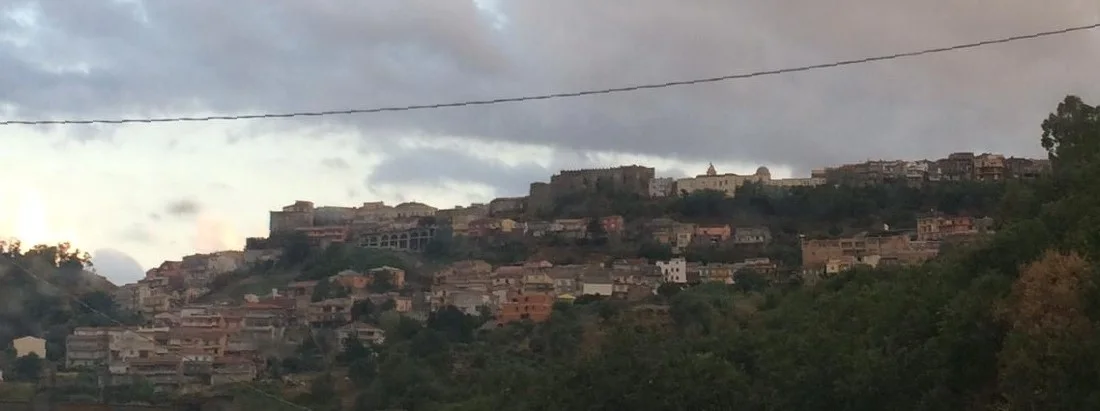
The coat of arms tells the story of a move. There are three green mountains — the central one is the hill the town stands on — and above them a crane holding a speckled snake in its beak and striking it, with the motto Devorat haec rostro pervigilatque pede. The crane is the watchfulness of the people who, after the Saracen raids, left the coast and climbed into the hills; the snake is the danger they had left behind. Down by the sea there had been Krimisa, which the ancients — Strabo, Apollodorus, Lycophron — credited to the Homeric hero Philoctetes, and there had been the temple of Apollo Aleo, whose capitals Paolo Orsi found.
The name, on the other hand, comes through the Greek of the Byzantines, and can be seen written in three documents: in a Latin deed of 1115 the Norman count Riccardo Senescalco grants land near a Castellum quod dicitur Psichro; al-Idrisi, in the Book of King Roger, records it in Arabic; and in a document of Frederick II's chancery of 1239 there appears a Parisius de Ypsicrò. The fief ended on 2 August 1806. In the courtyard of the Carafa castle the pavement traces a nine-pointed star attributed to Luigi Lilio, the man of Cirò whose calculations became the Gregorian calendar. And on 31 December 1951 the council voted the consensual separation of Cirò Marina, which by then had more inhabitants than the hill town: the settlement that had come up from the sea gave the sea a comune of its own.
No events match these filters.
📅 Every year, on 4 August
Cirò celebrates together Saint Francis of Paola and Saint Nicodemus the Abbot on 4 August.
Straight-line distances from the town centre. Tap a point to open its page.
The closest destinations covered by our editors, with straight-line distance.
Outside Cirò, but an easy day trip away.


