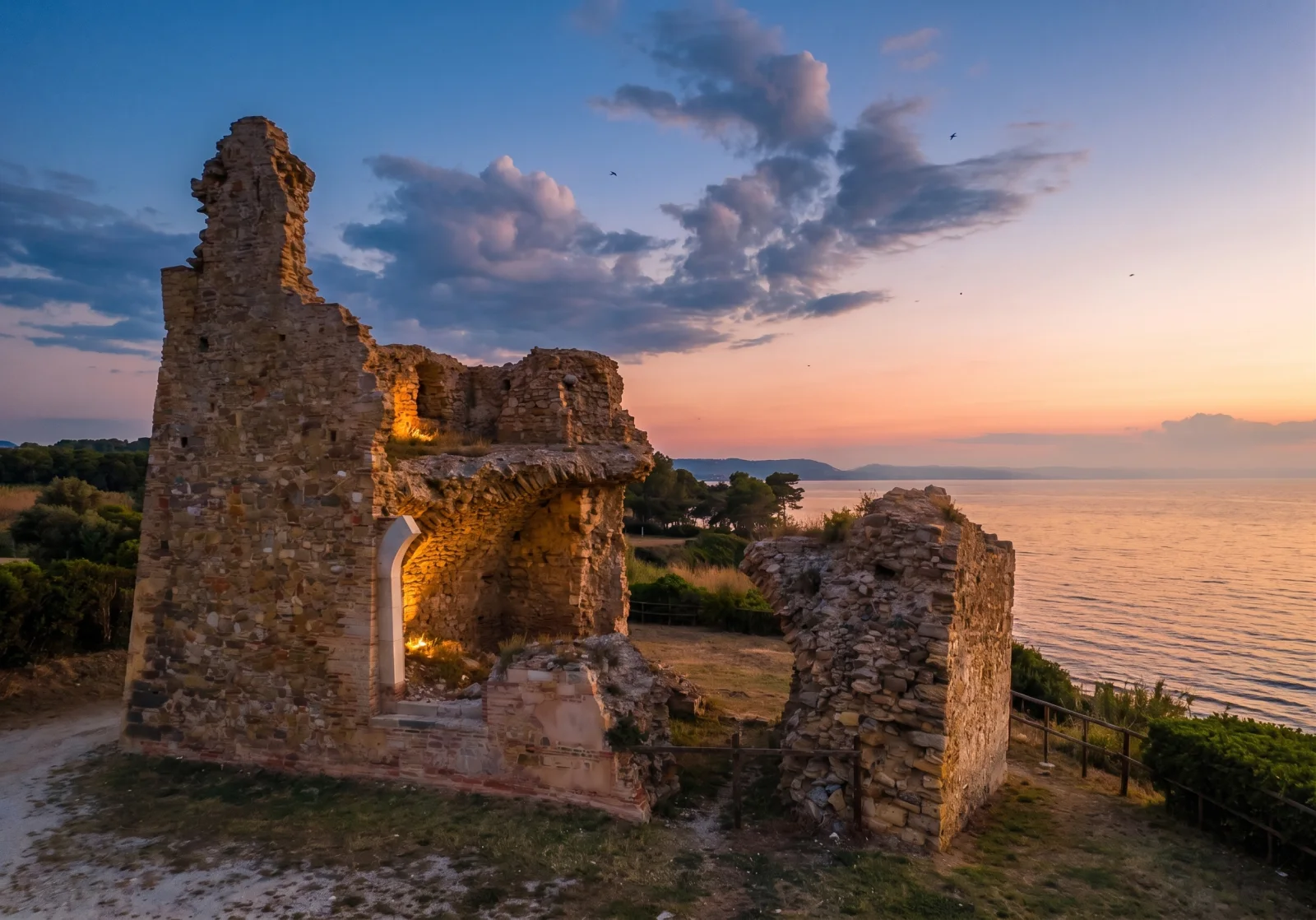
In 1777 a landslide gave way beneath the tower at Petacciato: the building split down the middle, the vaults came down, and the stump facing the beach dropped two metres and slid four to the north-east. It has stayed that way ever since, broken open and readable in section, a few metres from the shoreline along the SS16 coast road.
It had been built in 1568 and recorded in the survey of 1594; according to Gambacorta it was the twenty-fifth and last of the anti-Saracen towers of the Capitanata, part of the coastal system of the Viceroyalty of Naples. It exchanged signals with the towers of Montebello, the Trigno and the Sinarca. The trouble started at once, though, because the foundation ground along this stretch of coast slips of its own accord.
What to see
The model was the standard viceregal one: a square plan of 11 metres a side, a scarped truncated-pyramid body 12 metres high, mixed masonry, two levels. The ground floor held the stables, reached by a footbridge; the first floor was the lodging, with windows, a fireplace and a stair up to the armed terrace, where the sentry box stood behind a crenellated parapet carried on four heavy corbels per face. The ruin, oddly, shows all this better than an intact building would: the landslide's cut leaves the interiors open like a drawn section.
Our editors' tip
Look at where the tower came from, not only where it ended up. The step between the two halves records the movement of the slope better than any information panel, and explains why nobody, seven metres from the water, has ever been able to put it back up.


