In 1298, after the battle of Curzola, the Genoese locked a Venetian merchant named Marco Polo inside this building. He stayed a prisoner for almost a year and, to pass the time, dictated the account of his travels to his cellmate Rustichello da Pisa: The Travels of Marco Polo was born in the gaols of this palace. The building had gone up between 1257 and 1260 for the capitano del popolo Guglielmo Boccanegra, who wanted a seat of civil power separate from the cathedral; the designer was Friar Oliverio, a Cistercian monk who had already extended the Old Pier into the sea. They called it the sea palace, because the water washed its foundations.
What to see
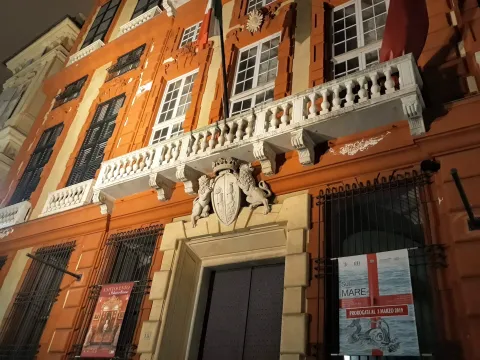
The building has two faces and it is worth walking around it to see both. Towards the city, under the Sottoripa porticoes, stands the medieval wing in stone and brick; towards the harbour, the Renaissance front added in 1570 and designed to be read by anyone arriving by ship. On that side the fresco shows Genoese notables and, in the centre, Saint George killing the dragon: Lazzaro Tavarone painted it between 1606 and 1608, after the Bank's Protectors had rejected the first version by Andrea Semino.
Much of what you see today, however, is a nineteenth-century interpretation. Alfredo d'Andrade, superintendent of monuments for Liguria and Piedmont, stripped away the additions of centuries and remade the medieval wing to the neo-Gothic taste of his own time: the Sala del Capitano del Popolo, the Hall of the Protectors and the Manica Lunga are hypothetical reconstructions, not surviving medieval rooms. From 1451 the building belonged to the Bank of Saint George, the institution created in 1407 by merging the Compere, which managed the republic's public debt until 1797.
Visiting
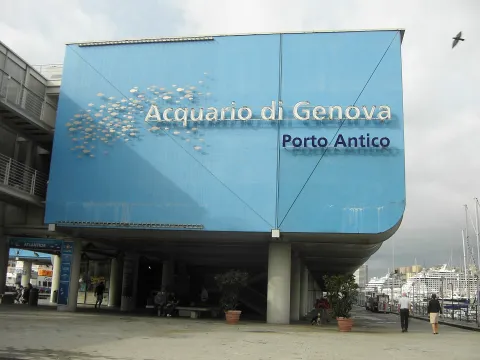
The palace stands between piazza Caricamento and piazza Cavour, facing the Porto Antico, a short walk from the Aquarium; the metro stop is San Giorgio. Since 1903 it has housed the port authority offices, today the Port System Authority of the Western Ligurian Sea: this is a working building, not a museum, and the historic rooms open only for special openings, exhibitions and events such as the Rolli Days. The exterior is always there, though: the elevated road opened in 1965 runs right in front of it and remains the plainest scar in the relationship between the city and its port.
Our editors' tip
Look at the palace twice, in different light. Early in the morning the painted façade catches the sun at an angle and the colours read clearly; at sunset, from the portico side, the medieval part falls into shadow and you understand how different the two halves are. And hunt along the porticoes for the fragments of the chains of Porto Pisano, war booty the Genoese hung here.