It was from this hillside above Loano that the Discalced Carmelites, meeting in two General Chapters between 1623 and 1626, decided to open a friary in Prague. The complex had been built a few years earlier for Gianandrea Doria: work began on 13 September 1602 to a design by the architect Rembado, and his son Andrea II brought it to an end on 22 March 1609. Napoleon suppressed the house in 1810, the friars returned in 1833, and the House of Savoy suppressed it again between 1855 and 1866. The Doria bought the property back in 1874 and handed it to the Carmelites for good in 1935. It has been on the list of Italian national monuments since 1910.
What to see
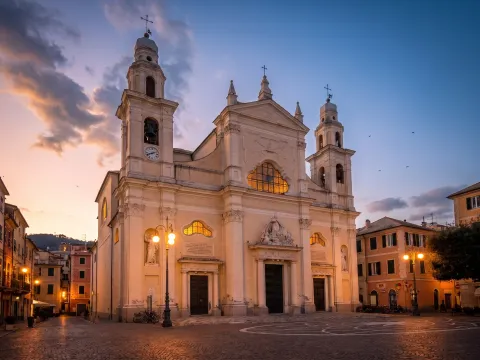
The church of the Madonna del Monte Carmelo stands at the centre of the complex: a Latin-cross plan, a dome on an octagonal base, a bell gable. Inside there is a single nave under a round barrel vault and no decoration at all; the high altar and the four side altars are of late Renaissance marble. Below the presbytery lie the tombs of the Doria princes, counts of Loano, buried here until 1793.
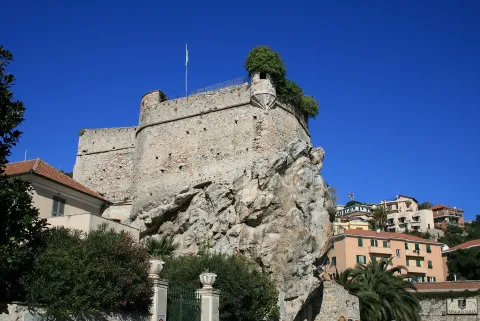
The canvases date from the early years of the seventeenth century and carry serious names: Domenico Cresti, known as il Passignano, Giovanni Battista Paggi and Francesco Vanni. The sculpture includes the processional wooden group of the Virgin of Carmel, an eighteenth-century work by Anton Maria Maragliano, and a fifteenth-century crucifix. East of the church the friary is laid out around its cloister, with kitchen gardens behind where medicinal plants are grown; to the west stands the Doria summer palace with its defensive tower, now divided into flats and private studios.
Visiting
The climb from Loano follows via Costino Montecarmelo, and the complex is entered by two wide, theatrical ramps, one from the east and one from the west. The church faces a square open to the town and the sea, and that is where almost everyone stops before going in. This is still a working religious house: opening times follow the community's timetable and the cloistered areas are closed to visitors.
Our editors' tip
We would come in the late afternoon, when the low light catches the gulf and the square in front of the church empties out. Once inside, look for the fifteenth-century crucifix: in a bare nave, with no stucco or fresco to distract you, it is the thing that stays with you longest.