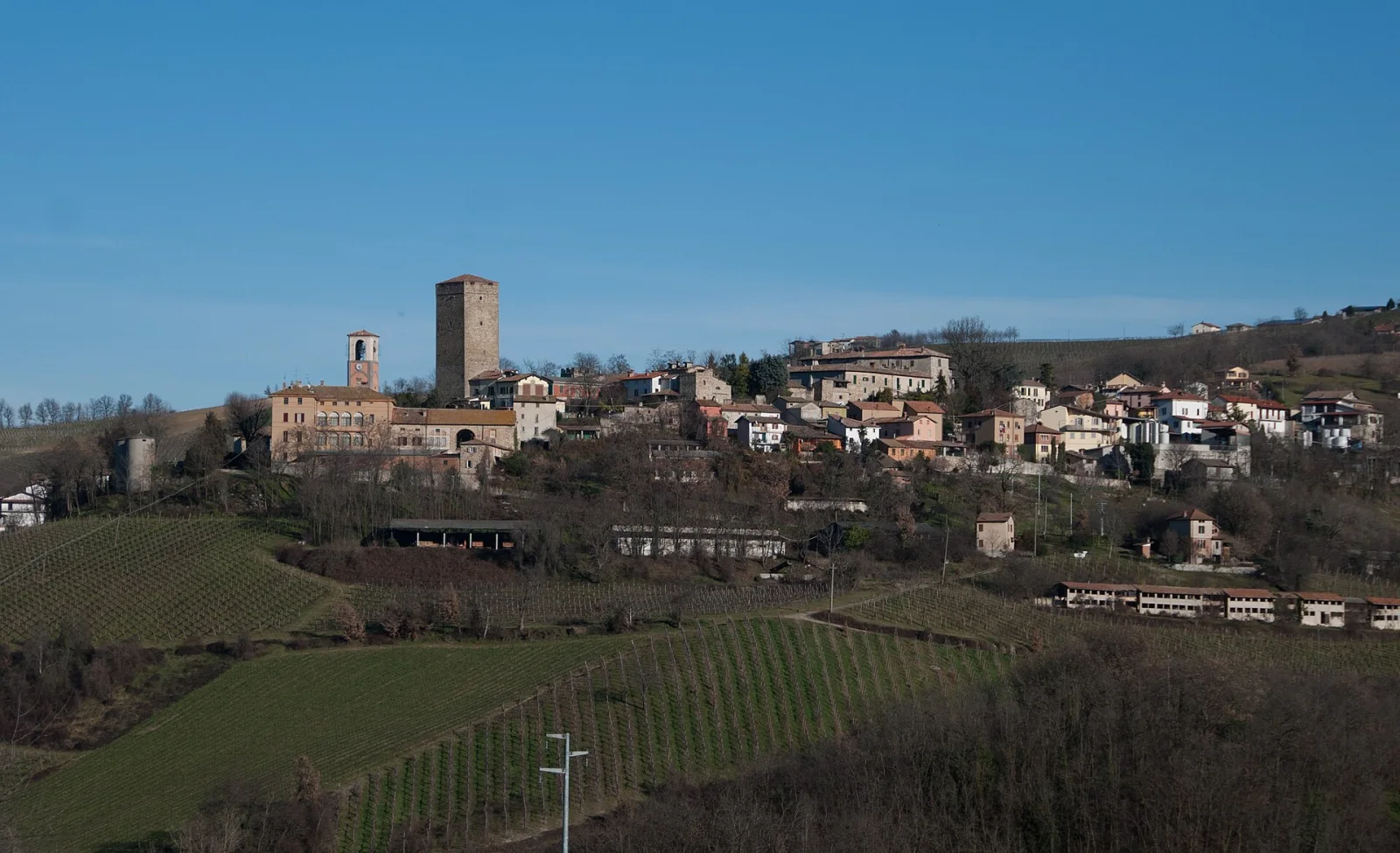
The village changed both its name and its place within a century. The old capital was Soriasco, up on the hill: known since the ninth century, when it belonged to the abbey of San Colombano at Bobbio, and placed under Pavia by Frederick I in 1164, it was a fief of the Giorgi, then of the Giorgi-Beccaria, and in 1690 it ended up with the counts Gambarana, who lived at the Casale of Donelasco. In the nineteenth century, however, at the foot of the hill and on the valley floor, a new centre began to grow, the Borgata Versa, also called Madonna della Versa after a small church built to remember an apparition of the Virgin to a girl. The town hall was moved there, and in 1893 the municipality stopped being called Soriasco and took the name of the church: Santa Maria della Versa. In dialect, more simply, "La Madòna".
In 1929 the municipality of Donelasco was joined to it as well, and at the beginning of the nineteenth century Montarco had already been absorbed, also called Sannazzaro after its parish church: a place that had mattered — it is named in Frederick I's diploma of 1164 — and that in 1216 was burnt by the Lombard confederates at war with Pavia. There is also an administrative oddity: the statute says the municipality has a coat of arms and a banner, but no act has ever defined them. In practice what is used is an emblem without a shield, an eagle with its feet on a wreath of laurel and oak surmounted by a viscount's crown, from which someone has since derived a proper coat of arms.
Straight-line distances from the town centre. Tap a point to open its page.
Near Santa Maria della Versa
The closest destinations covered by our editors, with straight-line distance.


