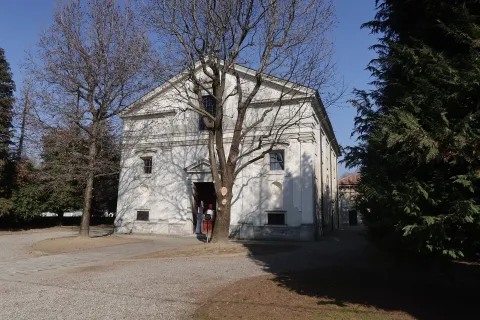
The Sacro Monte of Arona was never finished, and that is its story. The oblate father Marco Aurelio Grattarola imagined it just after the beatification of Charles Borromeo, on the hill behind the town where the saint had been born; the architect Francesco Maria Ricchino designed a triumphal arch at the foot of the hill and three paths, each with five chapels telling the saint's active life, and others higher up for the contemplative life. Three were built.
What to see
Today the complex consists of the sanctuary of San Carlo, the colossus and those three chapels, elegant in their classicism but now stripped of their decoration. In the sanctuary, above the high altar, hangs a canvas by Giulio Cesare Procaccini; behind the altar the saint's room has been reconstructed with the furnishings that escaped the Napoleonic destruction of the Rocca, and among the relics are his death mask and his sedan chair.
Visiting
From the square a stairway leads to the base of the colossus; facing the church stands the seminary of San Carlo, already completed in 1640 and now a school. The sanctuary was finished only in 1725, when the roof went on: more than a century after the first stone, laid by Federico Borromeo in July 1614 before an enormous crowd.
Our editors' tip
It is worth knowing why it ended this way: the promoter died, then came the great plague and the death of cardinal Borromeo in 1631. When work resumed in 1692, the papal architect Carlo Fontana scaled everything down, and what remained of the original idea was above all the statue.