Around 400 BC the Syracusan ruler Dionysius I founded Adranon on the south-western slopes of Mount Etna, on the site of a Neolithic settlement and beside a temple to Adranus, a fire god worshipped across Sicily and tied to the volcano's activity. The position guarded the Simeto valley and faced the Sicel town of Centuripe. Timoleon of Corinth took the city in 343–342 BC, and while he was sacrificing in the temple two killers sent by the tyrant Icetas tried to assassinate him — a local foiled the plot. Rome subjugated the polis in 263 BC and made it a civitas stipendiaria, a tributary town; the area was also known for the “simetite” variety of amber.
What to see
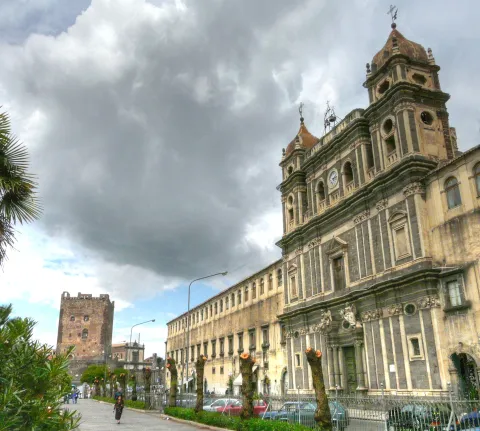
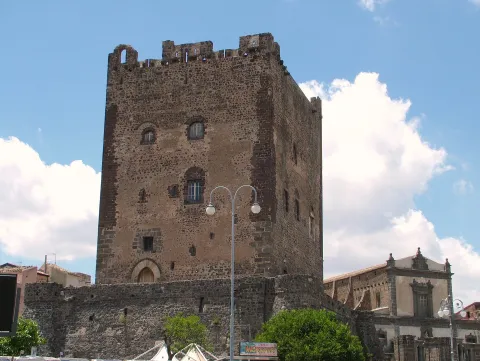
The best-preserved monument is the Greek circuit wall, built of basalt ashlar three and a half metres thick; a long stretch stands exposed on the east side, with a rectangular tower built against the church of St Francis, and the line of the wall lets you read the sixty hectares of the ancient city on the ground. Excavations have uncovered refined houses of the late 4th century BC with fragments of mosaic floors, and a road of the same date cleared for almost a hundred metres, lined with lava-stone channels for rainwater. The temple of Adranus has never been located, but sixteen basalt columns are set into the inner structure of the Chiesa Madre, next to the Norman castle in Piazza Umberto I — leading scholars to suppose the sanctuary once stood there. The Regional Archaeological Museum of Adrano gathers finds from the territory, including those from nearby Mendolito: an 8th–7th-century-BC hoard of some 800 kg of bronze, and a 6th-century city gate carrying a Sicel inscription that is still undeciphered.
Visiting
The first excavations date to 1959, and the site has never been dug systematically, partly because heavy building has buried the north side beneath the modern town; the wall area, however, has been laid out and opened to visitors. Adranon struck its own coinage — a series of 4th-century-BC bronzes minted under Timoleon bearing the river god Adranus. One celebrated local piece has left town: the bronze figure of a naked athlete, Siceliot work of the 5th century BC found in the Polichello district, is now in the museum at Syracuse.
Our editors' tip
Keep three nearby points together: the eastern stretch of wall, the Chiesa Madre with the basalt columns from the presumed temple, and the Norman castle in Piazza Umberto I, then finish at the Regional Archaeological Museum to put a face to the Mendolito bronzes. That way the stones scattered across the ground tell their city again.