Founded in the late 8th century BC, as shown by early Greek pottery, Helorus (Eloro) was the earliest sub-colony established by Syracuse. Occupying a 20-metre hill near the mouth of the Tellaro River, 8 kilometres southeast of modern Noto, the town was linked to Syracuse by the ancient Via Elorina mentioned by Thucydides. The surrounding area hosted the victory of Hippocrates of Gela in 493 BC and the Battle of the Assinaros in 413 BC. Controlled by Hieron II under the treaty of 263 BC, the city submitted to Marcus Claudius Marcellus in 214 BC and was later plundered by Gaius Verres in 71 BC before its final destruction during the Arab conquest.
What to see
The urban circuit walls, built from large mortarless ashlar blocks, date back to the 6th century BC and were reconstructed in the late 4th century BC. At the southeastern edge stands Torre Stampace, erected in 1353 by Blasco Alagona under Peter of Aragon atop an earlier coastal fortress cited by Pliny the Elder. Outside the walls lies the archaic sanctuary of Demeter and Kore, active from the 6th to the 3rd century BC; its worship later moved inside the city walls to a small temple in antis surrounded by a three-winged Doric stoa. Nearby, the agora features rainwater cisterns carved directly into the bedrock. Additional structures include a 4th-century BC sanctuary, likely dedicated to Asclepius, featuring a porticoed courtyard where the sick slept to await healing dreams, beside a small thesauròs treasury. On the southern slope, visitors can trace the remains of a late 4th-century BC Greek theatre, partially damaged by a drainage canal in the 1930s. To the northwest, the Colonna Pizzuta forms a monumental limestone funerary column nearly 10 metres high and 3.80 metres wide, adjacent to a rock-cut hypogeum excavated by Paolo Orsi in 1899.
Visiting
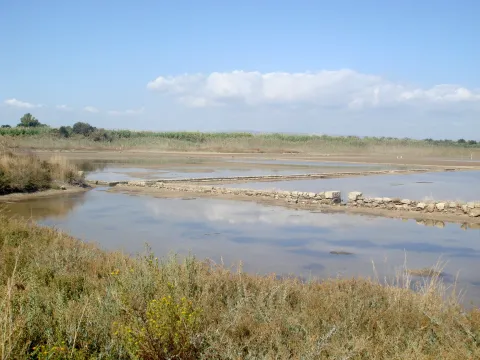
The site adjoins the Vendicari Nature Reserve, where segments of the ancient Via Elorina remain visible along the terrain. Due to a lack of security personnel and structural maintenance, official access to the enclosed archaeological field has been suspended for several years, resulting in partial damage to the boundary fencing.
Our editors' tip
Pair a visit to the perimeter with a trip to the Archaeological Museum of Noto, which houses the votive offerings recovered from the outer sanctuary of Demeter and Kore.