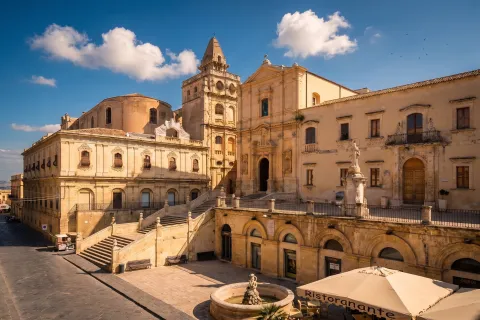
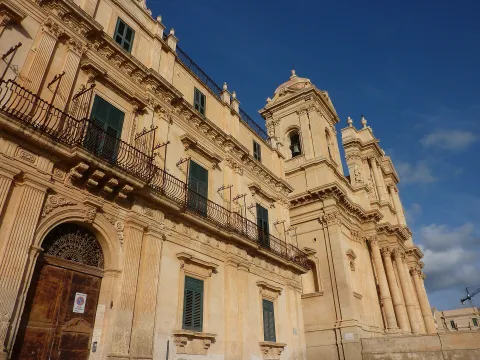
Cattedrale di Noto ★
The Baroque cathedral of San Nicolò in Noto, rebuilt after its 1996 collapse and part of a UNESCO World Heritage site.

 Museums Castelluccio di Noto An Early Bronze Age site near Noto featuring over 200 rock-cut tombs, including the monumental Tomba del Principe.
 Churches Cattedrale di Noto The Baroque cathedral of San Nicolò in Noto, rebuilt after its 1996 collapse and part of a UNESCO World Heritage site.
 Churches Chiesa del Santissimo Crocifisso Designed by Rosario Gagliardi in the 18th century, this is the second-largest church in Noto.
 Churches Chiesa di San Carlo al Corso Built from 1730, this Noto church features a golden calcarenite façade and an altar salvaged from the 1693 earthquake.
 Churches Chiesa di San Domenico A landmark of Noto's Baroque architecture, designed by Rosario Gagliardi between 1703 and 1727.
18 places covered in Noto Grouped by type, most important first.
No place with that name: try fewer letters.
The Baroque cathedral of San Nicolò in Noto, rebuilt after its 1996 collapse and part of a UNESCO World Heritage site.
Designed by Rosario Gagliardi in the 18th century, this is the second-largest church in Noto.
Built from 1730, this Noto church features a golden calcarenite façade and an altar salvaged from the 1693 earthquake.
A landmark of Noto's Baroque architecture, designed by Rosario Gagliardi between 1703 and 1727.
An 18th-century Baroque church in Noto designed by Rosario Gagliardi, forming part of the Val di Noto UNESCO site.
Rosario Gagliardi's church of 1730 on Via Ducezio, its portal framed by spiral columns and the Cistercian coat of arms.
An Early Bronze Age site near Noto featuring over 200 rock-cut tombs, including the monumental Tomba del Principe.
The ruins of Helorus, the earliest Syracusan sub-colony set on the Ionian coast near the Tellaro River.
Late Roman villa near Noto featuring 4th-century polychrome mosaics depicting mythical and hunting scenes.
The ruins of Netum on Mount Alveria, destroyed by the catastrophic earthquake of January 11, 1693.
Beneath ten metres of limestone, the tomb Paolo Orsi found in 1899: a grave, not a trophy.
Sicel necropolis above Noto: hundreds of rock-cut chamber tombs excavated by Paolo Orsi.
A canyon 507 metres deep, green pools at the bottom, houses cut into the rock.
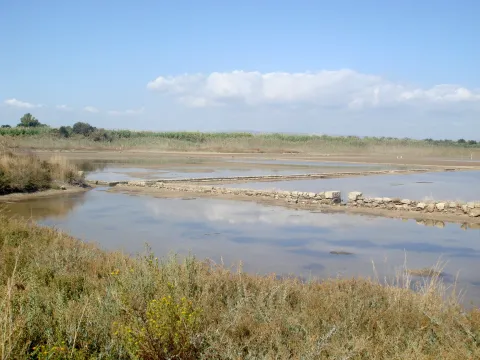
Salt marshes, a ruined tuna fishery and five beaches between Noto and Marzamemi.
Salt basins on the Pantano Grande, the tonnara chimney and, from December, flamingos.
Built in 1730 beside the cathedral of Noto by the marquesses of Sant'Alfano.
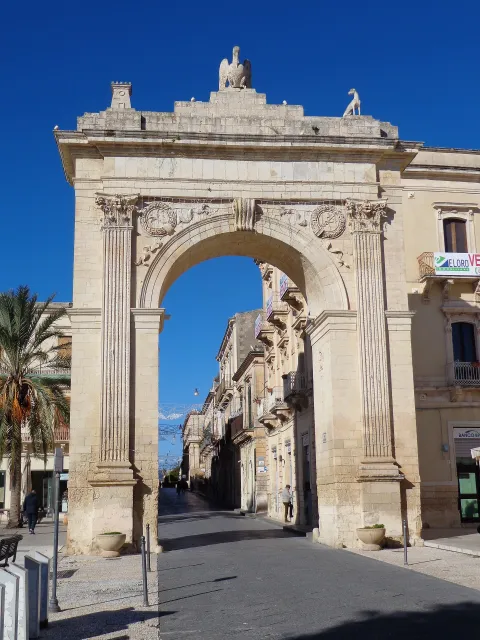
The arch Noto raised in a single year for Ferdinand II, whose statue is now the war memorial.
The neoclassical palace on via Cavour, shut for thirty years and reopened in 2018: 105 rooms.
The closest destinations covered by our editors, with straight-line distance.