The brick chimney of the tuna fishery still stands on the beach, above the broken walls of the sheds where the catch was processed. The tonnara of Vendicari was built in the 18th century, at its peak employed forty people under two rais, the first from Avola and his deputy from Pachino, and shut down in 1943. Next to it the Swabian tower, raised by the dukes of Noto in the 15th century, still watches this stretch of coast between Noto and Marzamemi.
What to see
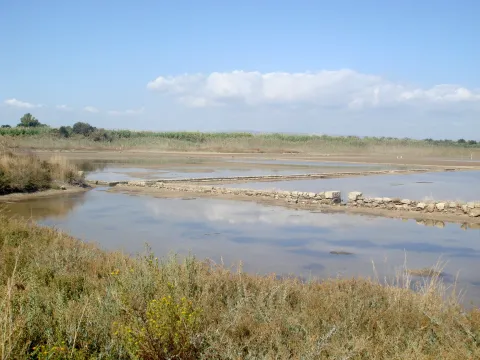
The reserve was established by decree on 14 March 1984 and made accessible in 1989; it covers 1,512 hectares of low coast, rock, dunes, scrub and salt marsh. The marshes are the point: Piccolo, Grande and Roveto lie a few dozen metres apart, average 30-40 centimetres deep, and the Piccolo never dries out, fed by brackish springs. About 180 bird species pass through each year, flamingos from France, ducks and waders from Russia, spoonbills and herons from Hungary, and the black-winged stilt stops here on the way from the Sahara to its nesting grounds in northern Europe. Africa is 350 kilometres away as the crow flies, and Vendicari lies further south than Tunis.
You also walk over archaeology here: the vats of a Hellenistic plant for salting fish, with a small necropolis beside them, and to the south the Cittadella dei Maccari, a Byzantine settlement with a small church and rock-cut tombs, abandoned by the 6th century when the coast turned dangerous and people moved inland towards Pantalica. Of the salt pans, working since the 15th century to serve the fishery, traces remain on Pantano Grande. There are five beaches: Eloro to the north, then Marianelli, Calamosche closed between two headlands, the one by the tonnara, and San Lorenzo at the far south.
Visiting
There are four entrances: Eloro to the north, Calamosche, the main one beside the Swabian tower, and Cittadella dei Maccari to the south. You come in from the road between Noto and Pachino, leave the car in the car parks at the gates and go on by foot: the paths are flat, sand and wooden walkways, with very little shade. The standard loop from the tower round the marshes takes three or four hours; crossing the reserve from Eloro to San Lorenzo takes a day. Hours follow daylight and change with the season, so check before setting off. Water and binoculars are not optional; December is the best month for watching birds.
Our editors' tip
We go in at opening time, through the tower gate, and reach the hides before the sun climbs: that is the hour when the marshes fill with long legs and the light lies flat on the water. Then we walk down to the tonnara and spend ten minutes inside the sheds, where the wind runs through the walls. In August the beach at Calamosche fills up: if we come in summer, we come early in the morning or at six in the evening.