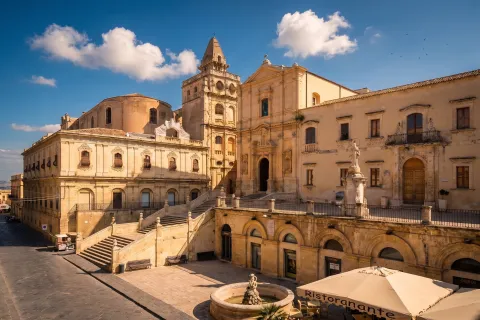
In 1730 Francesco Landolina, Marquess of Sant'Alfano, built himself a house on the most conspicuous spot in the new Noto: to the left of the cathedral, on the square that then carried his family's name and is now piazza Municipio. His father Giovanni Battista, a landowner and mathematician, was the man who after the 1693 earthquake obtained permission to rebuild the town ten kilometres downhill, and who set the rule: high ground for the nobility, the centre for the church. The son took the centre for himself.
What to see
The facade, attributed to Vincenzo Sinatra, is divided into three horizontal orders marked by squared pilasters with Corinthian capitals; windows and balconies carry rectangular architraves, and the family coat of arms runs along the top. It is a restrained front, already close to Neoclassical, aligned with the cornices of the cathedral rather than competing with the carved Baroque of via Nicolaci: the wealth on show here is the address, not the stonework.
The doorway opens onto a courtyard that once held stables and storerooms. On the right, two marble sphinxes flank the staircase up to the main floor, where the principal salon keeps gilded walls and paintings of the 18th and 19th centuries. Between 1838 and 1844 the palace hosted Ferdinand II of Bourbon and Queen Maria Theresa three times; on the open space in front, where a statue of the king by Tito Angelini once stood, there is now the First World War memorial.
Visiting
The palace stands on the cathedral square, along corso Vittorio Emanuele, which is pedestrian: you reach it on foot like the rest of the old town, and a good hour covers everything. Ten minutes are enough for the outside, best seen from the cathedral steps, the only point from which the whole facade reads at once. The interior has no fixed hours: it opens for guided visits, exhibitions and events such as Le Vie dei Tesori, so check before you come up. Palazzo Ducezio, also by Sinatra, and the bishop's palace face the same square.
Our editors' tip
We always come back in the last hour of daylight: the local stone turns orange and the three orders of the facade separate from one another in the shadows. We sit opposite, on the cathedral steps, which is also the place to understand why the palace stands there and nowhere else. If the door is open, step into the courtyard: the two sphinxes at the foot of the staircase are the thing you remember afterwards.