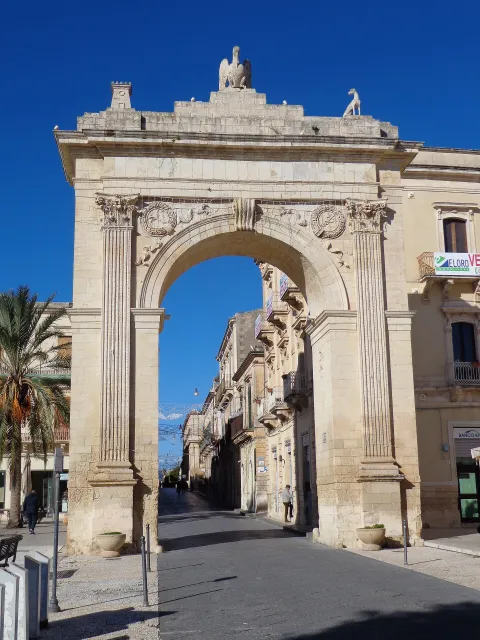
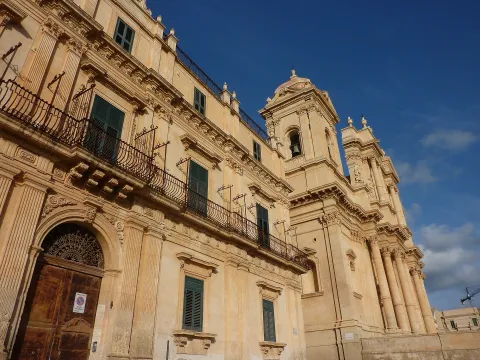
Designed by Syracusan architect Rosario Gagliardi alongside his disciple Vincenzo Sinatra, and constructed between 1704 and 1755, the Church of San Francesco d'Assisi all'Immacolata is a major landmark of Sicilian Baroque. Recognized as part of the Val di Noto UNESCO World Heritage site and designated a Marian Sanctuary on May 8, 2019, the church stands on Corso Vittorio Emanuele, the central avenue laid out on Mount Meti following the 1693 earthquake.
What to see
The exterior features a triple-flight staircase leading up to a limestone facade with four pilasters across two Corinthian orders, capped by a central triangular pediment. The main portal is framed by columns carved with vine scrolls and flanked by shell-shaped niches. Inside, the single-nave layout spans six bays with a lunetted barrel vault, featuring stucco decorations by Pasquale Cascone and Giuseppe Gianforma, trained in Giacomo Serpotta's Palermo workshop. The apse contains an 18th-century polychrome wooden statue of the Immaculate Conception attributed to Neapolitan sculptor Giacomo Colombo, depicting the Virgin in a gold dress and cobalt-blue starred mantle crushing a serpent-dragon. Wall paintings include the Massacre of the Innocents (1706) by Antonino Vizzini, The Ecstasy of Saint Francis and Saint Anthony Preaching to the Fish (both attributed to Vito D'Anna), and a 1783 Nativity. Sculpural highlights include a 1570s pitch-stone holy water basin brought from the ruins of old Noto, an 18th-century carved walnut pulpit beneath the triumphal arch, and a late medieval wooden crucifix (Christus patiens) flanked by 17th-century twisted wooden columns carved with grapevines and pelicans.
Visiting
Connected to an adjacent Franciscan monastery that was suppressed in 1861 and later converted into administrative offices and schools, the church remains an active parish. The interior displays mid-20th-century vault restorations alongside a 1964 high altar tabernacle crafted in bronze and chiseled silver.
Our editors' tip
Stand on the entrance steps to capture the perspective created by San Francesco and the southeastern wing of the neighboring Monastery of SS. Salvatore, one of the most iconic architectural views in Noto.