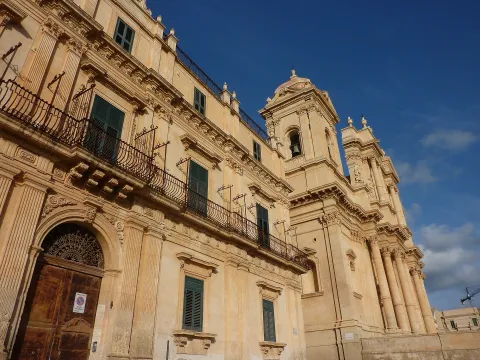
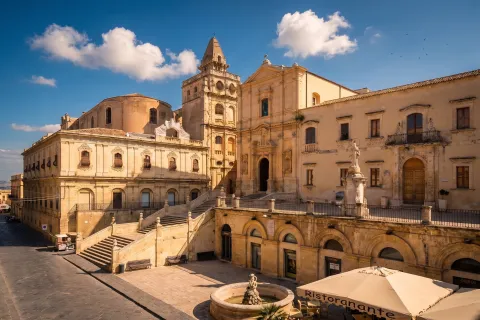
Designed by the architect Rosario Gagliardi and constructed between 1703 and 1727 for the Dominican Order, the Church of San Domenico stands as a key example of Baroque architecture in Noto. The Dominicans had been established in the area since 1344, when they founded their ninth Sicilian convent under the title of the Annunziata, before rebuilding their complex on this site following the 1693 earthquake.
What to see
The façade features two distinct tiers—Doric on the ground level and Ionic above—defined by alternating free-standing columns and niches. A convex central bay crowned by a broken curvilinear pediment generates strong chiaroscuro contrast. Inside, the church follows a central plan with three naves and a transept intersecting at the second bay. Above this junction, an external tiburio shelters the main dome, which is surrounded by four smaller exposed domes arranged symmetrically in an X pattern along diagonal axes. The interior contains stuccos and polychrome marble altars. Notable paintings include an 18th-century canvas depicting St. Dominic Receiving the Holy Spirit and a 1712 Madonna of the Rosary by Vito D'Anna. The third altar in the left nave houses a polychrome wooden Crucifix framed by seven Carrara marble relief panels depicting scenes from the Passion of Christ. At the high altar, polychrome papier-mâché and gilded wood statues of St. Dominic and the Madonna of the Rosary are set within a gilded wooden ciborium designed by Messina architect Antonio Basile. Of the adjacent former convent, which was mostly rebuilt after later serving as a school, the southern wing retains an original rusticated portal by Vincenzo Sinatra.
Visiting
From the outside, visitors can view the architectural arrangement of the roof, where the central tiburio and the domes of the four smaller outer vaults are visible, as well as Sinatra's rusticated portal on the southern face of the former monastery.
Our editors' tip
Pay close attention to the third altar on the left nave to examine the detail of the seven Carrara marble Passion reliefs, which are among the finest sculptural features preserved inside the church.