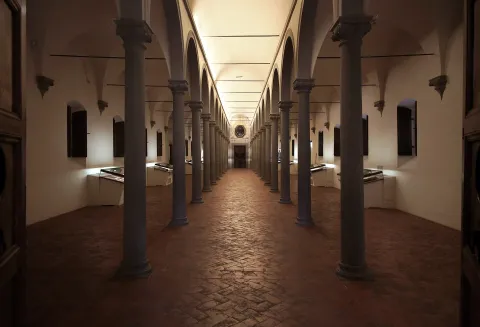
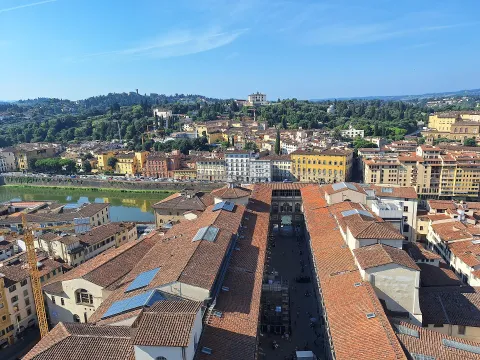
On via Cavour, between one doorway and the next, there is a small covered courtyard that can be visited free and in which there is almost never anyone. It was the cloister of a lay confraternity called dello Scalzo, because in processions the brother carrying the cross walked barefoot. To decorate it they called in Andrea del Sarto, who worked there on and off between 1509 and 1526: nearly twenty years for twelve scenes, in a courtyard in the middle of a block.
What to see
The stories are those of Saint John the Baptist, from the announcement to Zacharias to the beheading and the head carried to Herod, and they are all painted in monochrome, greys and whites imitating stone relief. It is a strange and beautiful choice: without colour there remain only drawing, light and bodies, and you watch a painter working like a sculptor. Two scenes are not his but Franciabigio's, painted while Andrea was in France working for the king.
In the niches are the allegorical figures of the virtues, and on the walls you can see the joins between one day's work and the next: the cloister is also a manual of how fresco was painted. The confraternity was suppressed at the end of the eighteenth century and its buildings were divided and sold; of the whole complex only this courtyard is left, which is why it looks today like a piece broken off something else.
Visiting
The cloister is on via Cavour, ten minutes on foot from the cathedral, just past palazzo Medici Riccardi; entry is free, but it opens only on certain days of the week and for a few hours, usually in the morning: check before setting out. Half an hour, and it is time well spent.
Our editors' tip
Do it straight after the cloister of Santissima Annunziata, five minutes away, where Andrea del Sarto worked in colour: putting the two one after the other, in the same morning, shows you in half an hour what changing technique means. And if you find the Scalzo shut, note it down for another time: it is one of the few things left in Florence that are free and empty.