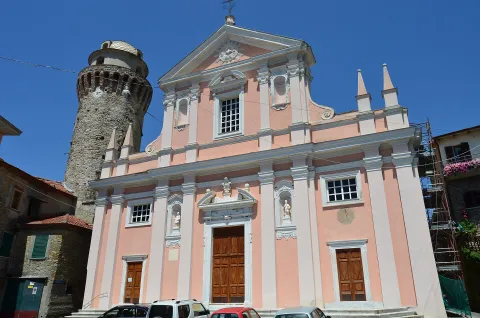
The tower of Castruccio is a military fortification at Avenza, in via Gino Menconi, near the Carrione stream and the Via Francigena; it is considered one of the most important places of interest in the city of Carrara.
What to see
A first military fortification, later also used to control trade, is recorded in 1311 in the list of the fortresses of the Empire drawn up for Henry VII, under the name «Castrum Aventia». The tower of Castruccio, however, does not seem to be part of that first nucleus: it would be the last testimony of the fortress that Castruccio Castracani had built, to enlarge and strengthen the castrum, between 1319 and 1328. After Castruccio's death, in 1328, the territory passed to various owners, including the Duchy of Milan, from 1343 to 1403; from 1473 to 1829 it was in the hands of the Malaspina and Cybo-Malaspina families, who modernised the tower and the rest of the fortification for the use of firearms, giving the building much of its present appearance. From the nineteenth century the fortification fell into disuse, because methods of warfare had changed; after Italian unification it was sold to private owners for two thousand lire, who demolished almost all of it to reuse the stone. In 1883 the historian Theodor Mommsen, passing through Avenza, noticed the destruction and protested to the authorities: the surviving tower was bought back for six thousand lire. Between 12 and 22 May 1944 Avenza was bombed by the Allies and the tower suffered further damage, remaining in its present condition.
The tower is cylindrical, with the base slightly wider than the top. In the broken section can be seen the twisted marble cornices built into the later masonry and the signs of a raising with a crown of gun-loops, probably of the seventeenth century. Inside, a tunnel can be glimpsed that in the past linked the fortification to the nearby piazza Carlo Finelli.
Visiting
The tower is in via Gino Menconi, at Avenza, near the Carrione stream and the Via Francigena. The sources consulted give no opening hours or arrangements for visiting the inside: check them.
Our editors' tip
In 2013 graffiti with the symbols of Christ's passion were found in the tower, left by prisoners held there between the sixteenth and eighteenth centuries; in 2015 two more passages came to light, one towards the banks of the Carrione and one towards the centre of the old village. Local legends speak of a dense network of tunnels around the tower, but for now it is only a hypothesis.