Before the church there was a Byzantine chapel, raised between the sixth and seventh centuries in thanksgiving for the capture of the old Roman colony of Luni. The Lombard king Rothari had it levelled. In the eleventh century work began again on the same spot, the highest point of the small walled village of Nicola, and from that rebuilding descends the church of Santi Filippo e Giacomo. In the fifteenth century, once Nicola's jurisdiction had widened, the building was raised to parish status and the parish itself was founded.
What to see
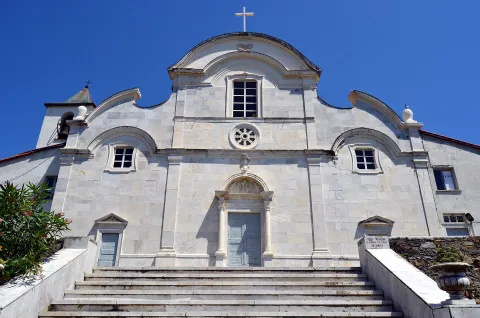
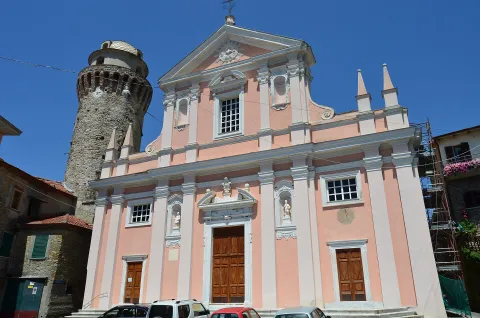
The facade is yellow today; it used to be pink. Marble statues of the two patron saints stand on either side of the pediment. Inside, the plan is a Latin cross with a single nave and Baroque decoration, the outcome of two building campaigns: in the sixteenth century the church was extended towards the square and lifted by more than a metre, and in the seventeenth a second round of consolidation and enlargement gave it the shape it has now. The restorations of 1820 and 1975 left that structure untouched.
Most of the artworks sit along the perimeter. Beside the font is a statue of Saint John the Baptist dated 1585. At the second altar on the left hangs a painted panel of the Crucifix from the thirteenth-century Pisan-Lucchese school: it is the oldest thing the building holds. In the transept the Virgin of the Rosary dates from the late sixteenth century; in the presbytery the relief of the Twelve Apostles carries the date 1537. The canvas by Riccardo Martinelli, a painter from Carrara, is seventeenth-century work.
Visiting
Nicola is a hamlet of Luni, in the lower Val di Magra, reached by the road that climbs from Ortonovo through olive groves. The village is tight and enclosed: leave the car outside the walls and carry on uphill on foot, because the church sits at the top and therefore comes last. There are no museum hours here. The parish belongs to the Bassa Val di Magra vicariate of the diocese of La Spezia-Sarzana-Brugnato, and opening follows the services, with Sunday morning the safest bet.
Our editors' tip
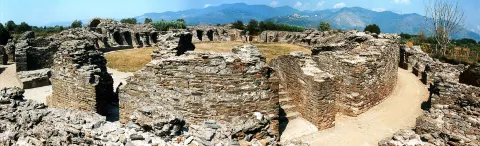
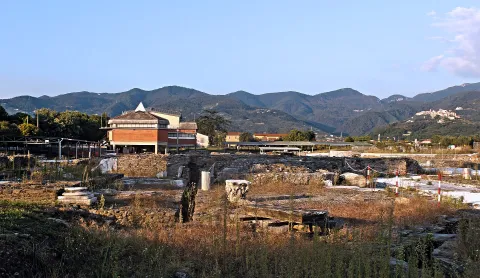
Turn around on the forecourt before you go in: from up there you can see the plain where Luni stood, the city whose conquest that first chapel marked. Inside, give a few minutes to the thirteenth-century Crucifix in the darkest stretch of the nave. A small torch helps a great deal, and the gap between that painted wood and the Baroque around it is worth the drive.