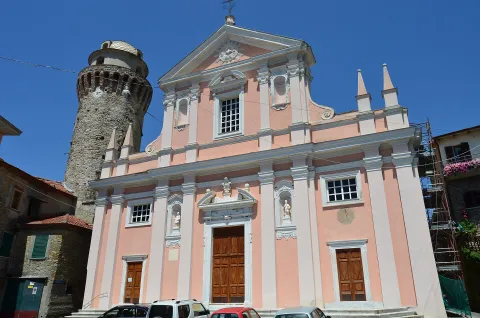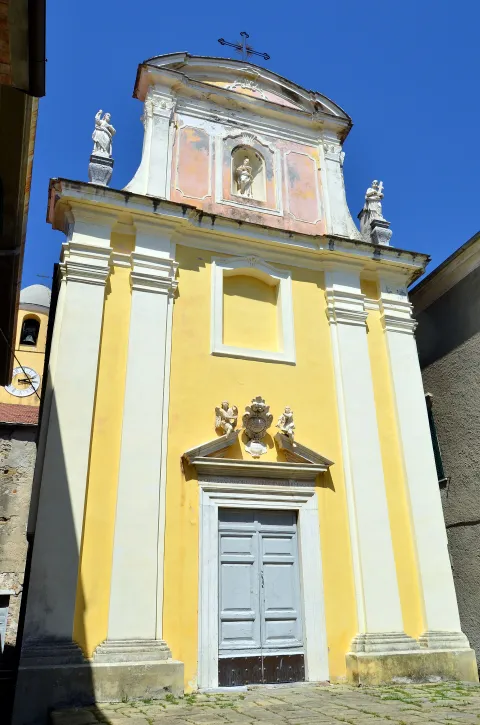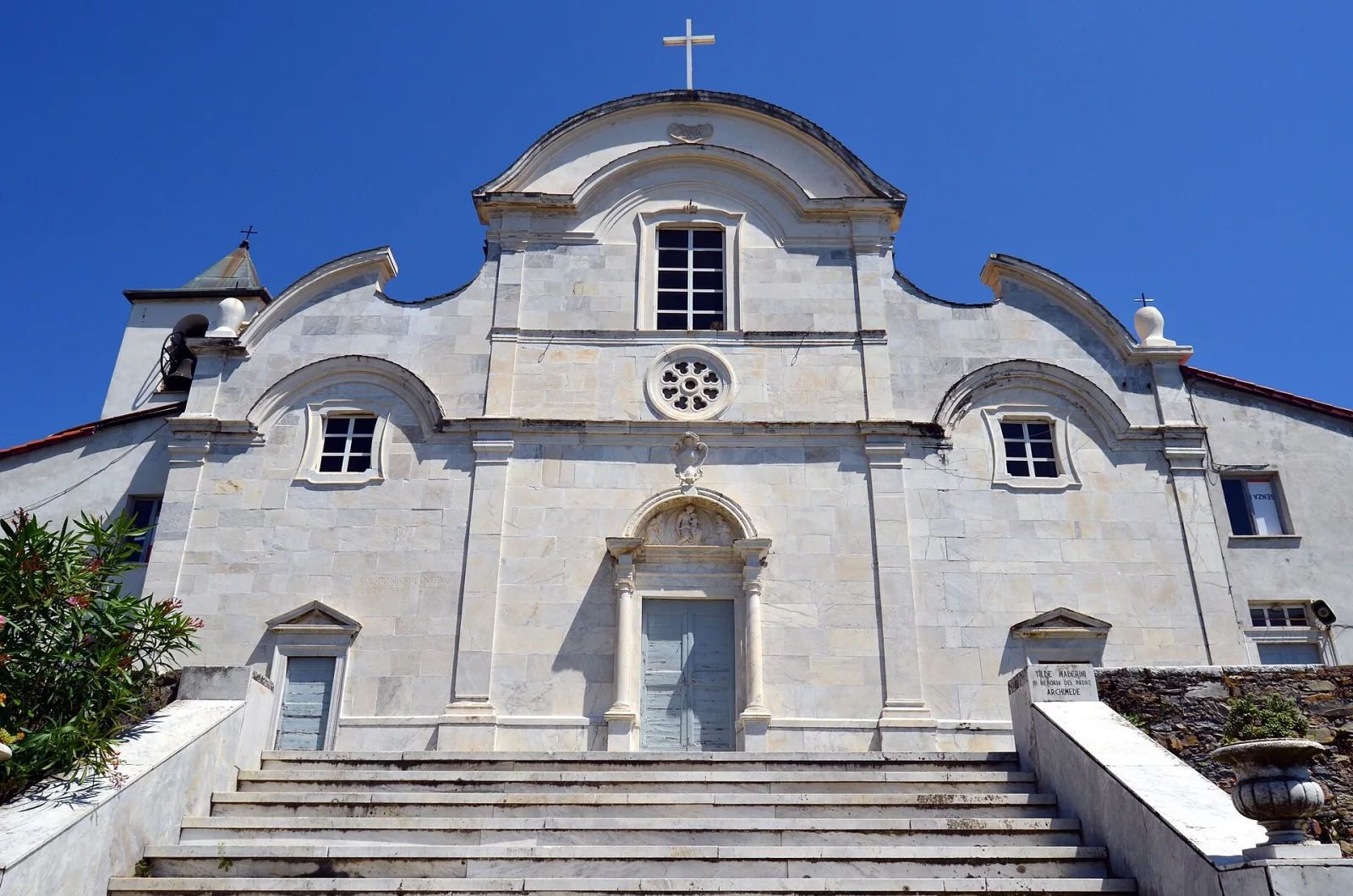
In 1537 a painting of the Virgin at the foot of the cross, in a small oratory on monte Boscaccio, began — so the faithful said — to weep tears of blood. The oratory, dedicated to Santa Maria del Mortineto and served by the confraternity of the Disciplinanti, had been built around the fifteenth century and could not hold the flow of pilgrims that followed: in 1540 the architect Ippolito Marcello of Lucca started work on a far larger building, completed in 1566. That is the sanctuary you see today, south of the old centre of Ortonovo, a hamlet of the municipality of Luni.
What to see
The façade deserves the first look: in the lunette above the architrave, a high relief shows the Virgin and Child between two devotees wearing what look like the robes of the local confraternity. The work was once attributed to a young Michelangelo; opinion now favours a sculptor from Lucca who studied Michelangelo very closely. At the centre opens a rose window faced in white Carrara marble, stone that around here comes from the quarries next door.
Inside, three naves are divided by two rows of Corinthian pillars carrying the vaults of the ceiling and the arches of the chapels. In the middle stands the octagonal shrine in polychrome marble, cut by the Carrara stonemason Scalabrini in 1796, which holds the painting of the Deposition from the Cross. The other additions tell the Dominican chapter: the friars took over from the confraternity priors in 1584, built the sacristy and an adjoining convent in 1601, and added a new choir behind the sacred aedicule in 1650.
Visiting
The sanctuary is still in use: from 1933 to 2003 it was held by the Orionine fathers, and today it is looked after by priests of the Fraternità Missionaria di Maria, a community founded in Guatemala. You reach it by climbing from Ortonovo towards monte Boscaccio on a narrow road; the forecourt in front of the church is the best place to stop, with the Luni plain and the sea behind. Avoid mass times if you want to look at the nave in peace.
Our editors' tip
Give yourself two minutes under the lunette before going in, with the morning light striking it sideways: that is when you understand how anyone could have thought of Michelangelo. And weigh the name: it was Mortineto, and it turned into Mirteto only under French rule, perhaps through a plain slip of transcription, after the Dominicans were expelled from the sanctuary and from the village in 1800. They came back in 1888, when Giacinto Rossi, bishop of Luni-Sarzana and Brugnato, handed them a building that had been shut and left to decay.