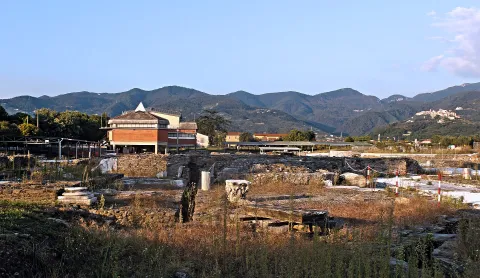
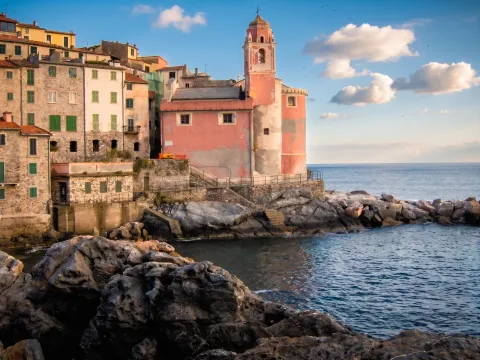
On the floor of the calidarium pool someone, nearly two thousand years ago, laid a waterproof plaster and painted it turquoise: the point was to make water heated by a wood-fired furnace under the floor look like seawater. It is the best preserved detail of the Roman villa of Bocca di Magra, a maritime villa of stepped terraces built down the slope of Monte Caprione, on the right bank of the Magra, facing the port of Luni with the Apuan Alps in view.
What to see
The villa went up in the first century BC and was altered repeatedly until the fourth. It belongs to the family of large Augustan-age villas along the Tyrrhenian side of Italy, aristocratic houses with their own seafront and bathing installations, built for otium; on the eastern Ligurian coast only the villa of Varignano keeps it company. Statius and Persius were probably guests here and wrote in praise of the place.
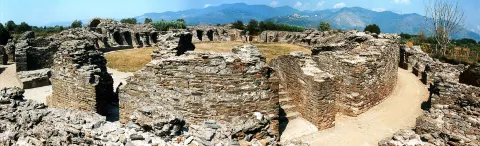
The plan is complicated because it had to knit together levels dropping towards the sea: porticoes, terraces, stairs, corridors. The oldest walls are of stone; the late repairs are easy to spot, made of salvaged material, brick and marble, bound with a mortar poor in lime. Of the baths the calidarium survives, with the duct that carried hot air beneath the floor. A circular stamp on the bricks of its ceiling carries the capricorn of C. Iulius Antimachus, and that is what dates this part of the building to the end of the first century AD. Two Corinthian capitals suggest a colonnaded terrace, and fragments of painted plaster, foliage, flowers, theatrical masks, show how well appointed the house was.
Visiting
The site lies in the municipality of Ameglia, at Bocca di Magra where the river meets the sea, and it is an open-air archaeological area: no rooms, no museum route, just walls and floors to read. Check the opening arrangements in advance, since they depend on the Soprintendenza and are not continuous, and wear closed shoes: the ground slopes and in summer the grass grows tall.
Our editors' tip
Bring a bottle of water and give ten minutes to the calidarium alone, crouching at the rim of the pool until you pick out the turquoise under the crust. Then look up towards the Apuan Alps: the villa was planted here for that view and for the port of Luni below, not by accident.