In 860 a Viking fleet sailed up the Tyrrhenian coast and sacked Luni. According to the chronicles, the leaders Björn Ironside and Hastein believed they had reached Rome, and Hastein had the gates opened by pretending to be a dying convert. The mistake says a great deal about how rich and conspicuous the city still looked from the sea. Rome had founded it in 177 BC at the mouth of the Magra as a military outpost in the war against the Apuan Ligurians, on top of an Etruscan trading post already in use: the name of its harbour, Portus Lunae, appears in the sources before the colony existed.
What to see
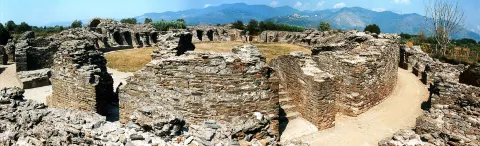
The archaeological area still shows the strict grid of the colony: the forum with the Capitolium, where in 1851 an inscription of 155 BC was found, dedicated to the consul Claudius Marcellus for his triumph over the Ligurians; the theatre; and, outside the walls, the large elliptical amphitheatre built in the 2nd century under the Antonines, with room for 7,000 spectators, still the most legible building on the site. By the end of the 6th century the forum had stopped working as a public space, and archaeologists found the remains of small wooden houses standing on it.
Luna's fortune came from marble. From the 1st century BC the city was the shipping port for the white marble of the Apuan Alps, the marmor lunense, which left from here for Rome along with timber, cheese and wine; Pliny the Elder rated the big wheels of Luna cheese the best in Etruria. The national archaeological museum inside the site displays portraits, inscriptions and architectural fragments, most of them from the excavations of the 1970s.
Visiting
The site lies in the hamlet of Luni Scavi, in the municipality of Luni — called Ortonovo until April 2017 — in the province of La Spezia, between Sarzana and Carrara and minutes from the Aurelia road. Excavations and museum are state property, run by the regional museums directorate of Liguria: opening times and the weekly closing day change with the season, so check them before you set off. Almost the whole route is outdoors, on beaten earth and grass, so wear closed shoes and bring water and a hat in summer.
Our editors' tip
Go in the late afternoon, when the low light brings back the cart ruts, the door sills and the cut letters of the inscriptions. And keep one date in mind: 1471, when Sarzana built its own town hall with dressed stone carried off from here, despite a papal ban issued ten years earlier. Among these ruins you also look at what is missing.