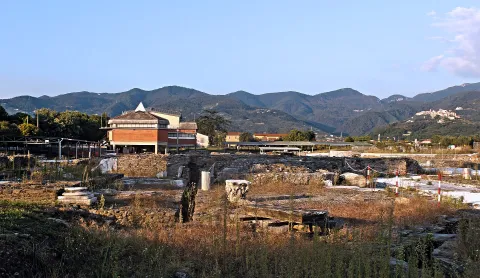
The amphitheatre of the Roman colony of Luna is an ellipse 88.5 metres by 70.2, sized for about 7000 spectators. It was built in the second century AD, perhaps in the Antonine period, in the eastern quarter of the city and along the old line of the via Aurelia. Its orientation is not that of the Republican colony: it follows the Augustan land division, which had been laid over the older grid at a different angle. That detail places the building in time better than any inscription: by the time it went up, the city had already redrawn its own plan once.
What to see
Nothing is left of the tiers of seats: what you walk around are the substructures, the elements that held them up, arranged in two concentric rings of vaulted chambers. Stairs and passages cut into the inner ring led to the lower seats, the ima cavea; the upper rows, the summa cavea, were reached instead by a series of stairs opened in the outer ring. The arena was bounded by a covered corridor entered through vaulted doorways.
The materials repay attention. The frame is all cement conglomerate, but some parts were faced in stone: the vaults of the stairs with small blocks of schist from Monte Caprione laid irregularly, opus incertum; the main doors with regular blocks of grey limestone and sandstone pebbles, the technique archaeologists call petit appareil. There was also a system for rainwater: a drainage channel along the arena corridor and, in the summa cavea, terracotta channels set into the outer walls. Tiles, roof covers and antefixes found in the excavations show that the upper order of seating was roofed by a gallery.
Visiting
The amphitheatre lies within the area of the National Archaeological Museum of Luni, in the municipality of Luni, province of La Spezia, and is seen together with the rest of the ancient city. Like almost all Roman amphitheatres it stood outside the monumental centre, beyond the built-up area, so reaching it means stepping out of the forum circuit. Keep it for last, once the plan of the colony makes sense: only then does the ellipse, set askew to the streets, say something.
Our editors' tip
We suggest walking the whole outer ring before going in: from outside you can read the two files of vaulted chambers one inside the other, and understand how the machinery of stairs worked. Then look on the vaults for the dark schist of Monte Caprione, the stone of the hills that close the plain, fitted here into a Roman public building.