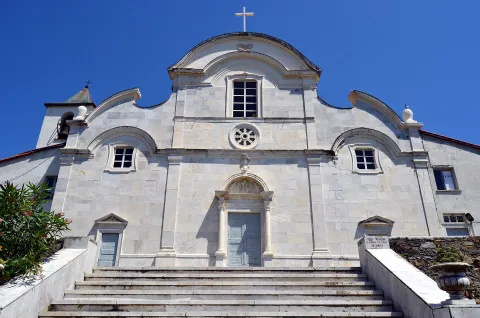
The building you see went up between 1621 and 1645 on the ruins of a medieval castle, at the south-eastern edge of the village of Ortonovo: the church of San Lorenzo stands on a fortification, not on an earlier sacred building. Solemn consecration came on 5 February 1651, performed by the bishop of Lacedonia, Monsignor Ambrosio Viola. In 1714 a bull of Clement XI raised it to the rank of perpetual abbey, a title still audible in the name of the parish of Santi Martino e Lorenzo.
What to see
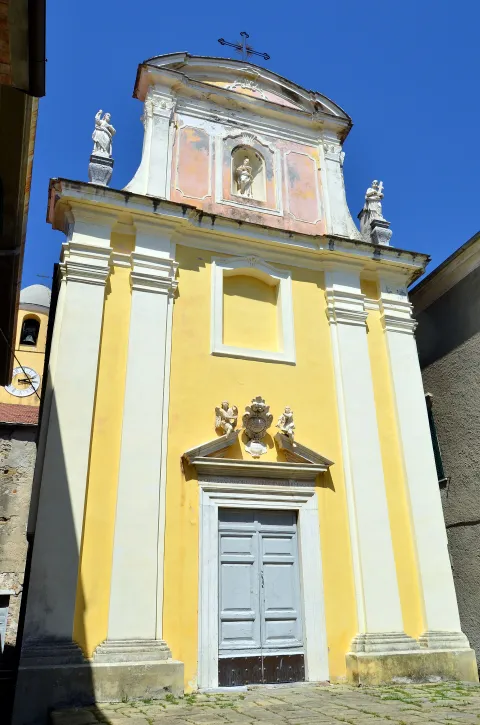
The facade is pink and Baroque; two niches hold statues of Saint Martin and Saint Lawrence, both carved in 1754. Inside there are three naves, separated by two rows of pillars that carry the dome and the vaults, and ten side chapels: generous for the parish church of a hamlet, and explained by the abbey rank granted in the eighteenth century. The floor, in slabs of white marble, was relaid in 1910. Above the entrance, the pipe organ came out of the Serassi workshop in Bergamo in 1884, one of the leading organ-building families in Italy.
The chapels reward going round one by one. At the first altar on the right stands a statue of Saint Anthony the Abbot from 1727; at the third, a sixteenth-century Saint Roch; at the fourth, the Ecstasy of Saint Francis, painted in the eighteenth century by an artist who remains unidentified. Beside the high altar is a statue of Saint Lucy, and a little further on Saint Anthony of Padua with the Christ Child. Among the canvases, look for the Madonna and Child with Saint Dominic and a martyr saint whose name nobody now knows. The pulpit is eighteenth-century.
Visiting
Ortonovo is now a hamlet of the municipality of Luni, in the lower Val di Magra, and the church faces piazza di Sotto in the lower part of the village: the one place here you reach without climbing. It is a few minutes by car from the Carrara or Sarzana motorway exits; park along the road and walk into the old centre. The parish of Santi Martino e Lorenzo belongs to the Bassa Val di Magra vicariate and opens for services; outside those times it is worth asking locally.
Our editors' tip
If you arrive while the organ is playing, stay: the Serassi is still in place above the door, and in a three-nave church under a dome it gives what it has. Otherwise our suggestion is to pair this visit with Nicola, the other walled hamlet of Luni, a few minutes away: two churches, two periods, the same vicariate, and the Roman plain in view the whole time.