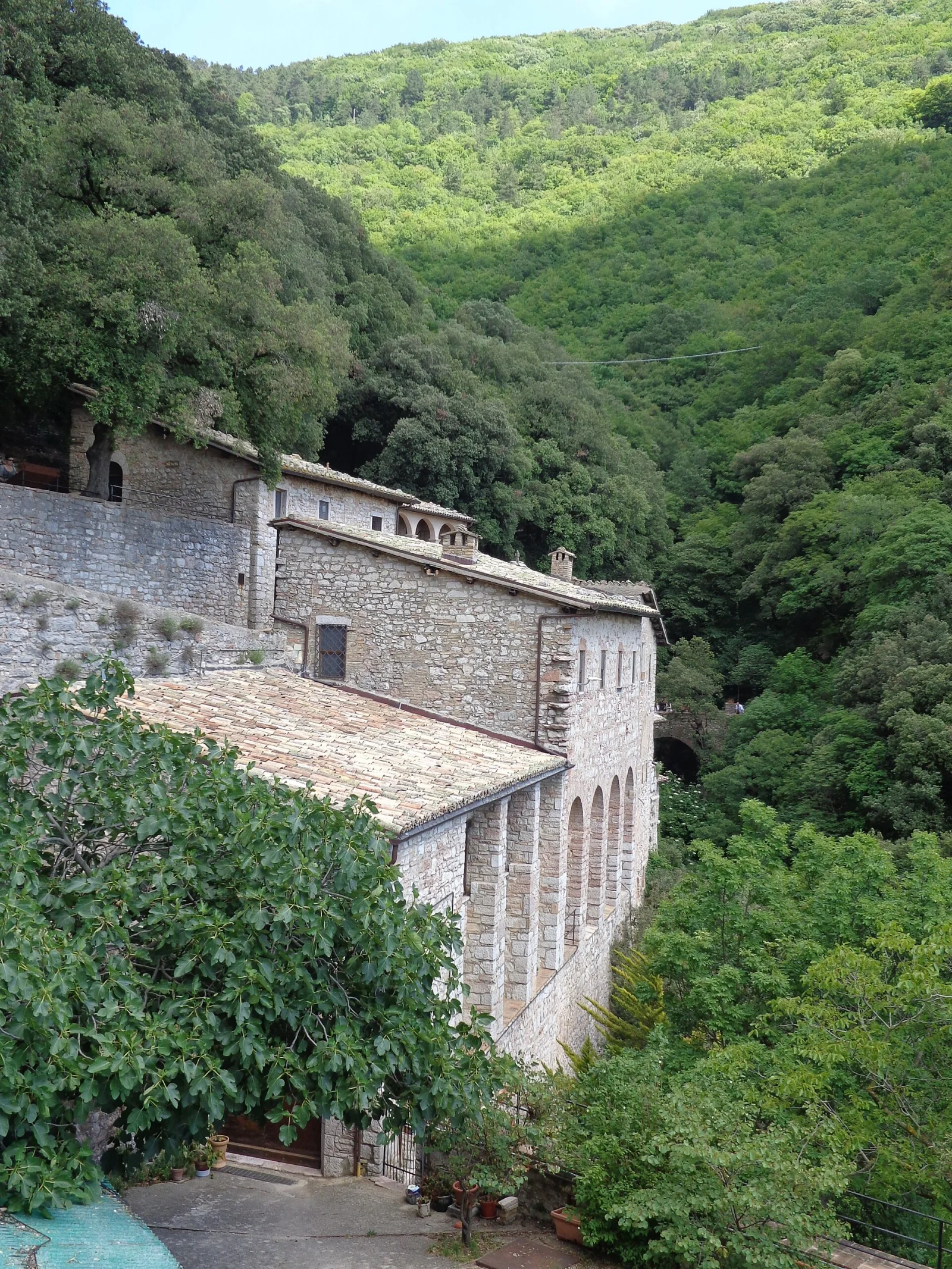
Four kilometres above Assisi, inside the woods of Monte Subasio, is the place Francis went when he wanted to be quiet. It is called the hermitage of the Carceri because the carceri were the caves in which the friars withdrew alone, cut off from the world for days: not a convent, but a handful of holes in the rock above a ravine. Later, in the fifteenth century, Saint Bernardino of Siena had the small building you see today put up there, clinging to the mountain like a nest.
What to see
The convent is tiny: you pass through low doors into narrow rooms, go down a little stair cut in the stone and reach the cave of Saint Francis, with the rock bed where he slept. There is nothing to see, strictly speaking, and that is exactly the point: a few square metres of bare stone, whose force lies in having been left as they were.
Outside you come out into the wood, onto a small bridge crossing the dry torrent — tradition says Francis ordered the water to stop making noise and the bed has been empty ever since — and reach the great holm oak where, the story goes, the birds gathered. From the paths around, walks lead to the other caves and up to the summit of the Subasio, where the wood ends and the open meadows begin.
Visiting
The hermitage is reached by car from Porta Cappuccini, four kilometres of narrow steep road with limited parking, or on foot in a good hour of climbing through the wood; free entry with an offering, run by the friars, open daily in daylight hours. An hour, longer if you walk in the wood. Walking shoes: inside there are uneven steps and low passages.
Our editors' tip
Go early, before the coaches, and once there do not stop at the convent: take the path down into the wood and walk for ten minutes, until you can no longer hear anyone. It is the only way to understand why a man who had chosen to live among people climbed all the way up here whenever he could.


