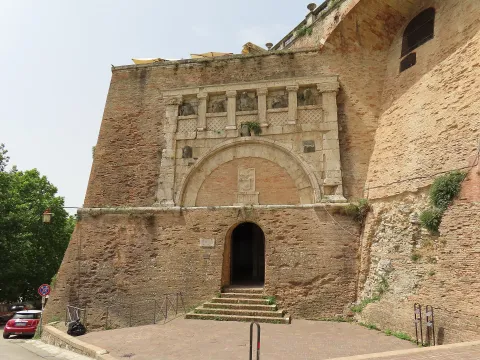
The Church of Sant'Ercolano stands in Perugia at the junction of via Sant'Ercolano and viale Indipendenza, set against the Etruscan walls next to the staircase bearing the same name.
What to see
Built between the late 13th century and the early decades of the 14th, the church was dedicated in 1317 by the Commune of Perugia to the city's patron saint Ercolano, a bishop martyred in 540 during the city's siege by Totila; originally more imposing, with a second chapel on the upper floor, it lost that chapel in 1542, when it was demolished because it blocked the view of the new Rocca Paolina. After a period of neglect, Bishop Napoleone Comitoli promoted its restoration, and in 1607 the church was entrusted to the Barnabite fathers, who reopened it for worship; they remained there until 1777, when the building passed to the Compagnia di San Martino, still its owner today as the Fondazione Sodalizio di San Martino.
With a central octagonal plan, the church rises vertically more like a tower than a religious building, with a bell tower that displays a clock. The vault frescoes, painted by the Genoese Giovanni Andrea Carlone in 1675, are among the city's most important examples of illusionistic Baroque painting, with a false dome painted above the Gothic cross vaults; the side chapels preserve stuccoes by the Frenchman Jean Regnaud of Champagne and, in the apse, a 17th-century copy of the Pala dei Decemviri, whose original by Perugino is now in the Vatican Picture Gallery. The altar is fashioned from a 3rd-century Roman sarcophagus decorated with hunting scenes. After the First World War the church also became a war memorial.
Visiting
The church, subject of a major restoration completed in 2006, is open for worship according to service times.
Our editors' tip
Look up at Carlone's false dome: from outside the church looks like a compact fortress, but inside the painted illusion opens the space upward, a contrast that alone is worth the visit.