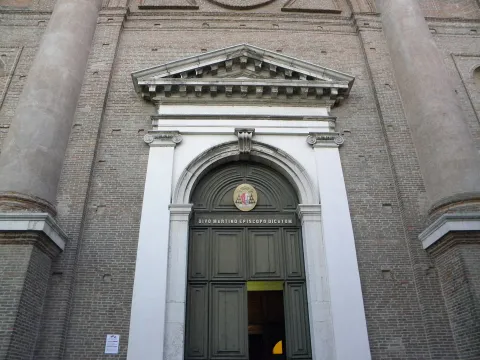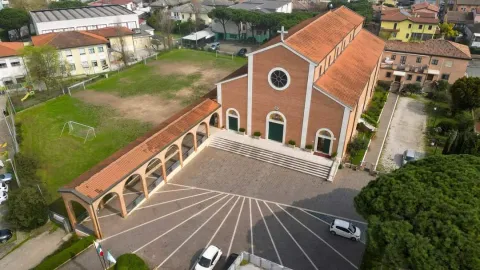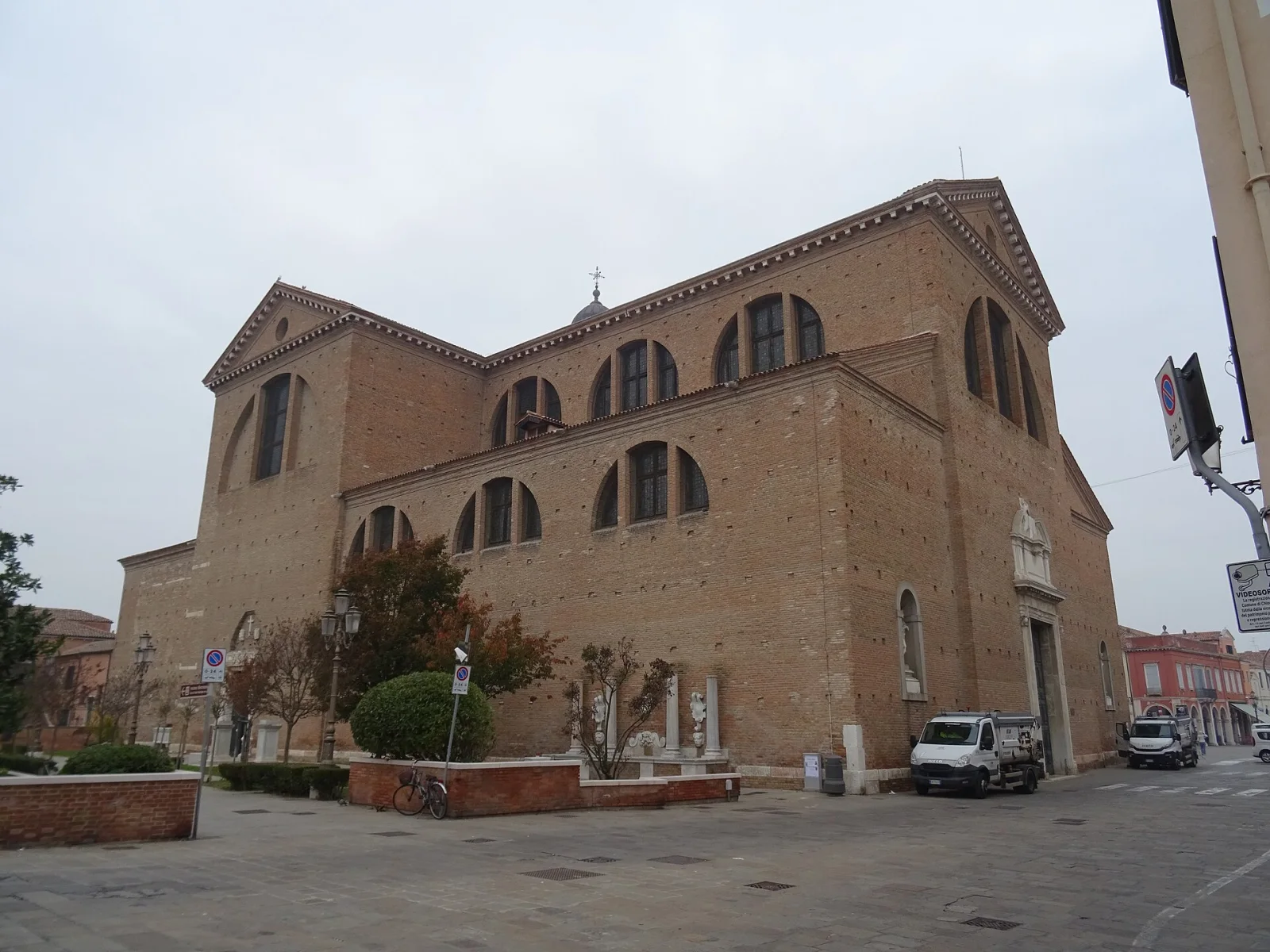
The cathedral of Santa Maria Assunta is the mother church of Chioggia and of its diocese, and a national monument. When the bishop's seat was moved here from Malamocco in 1110, the cathedral was a Romanesque church built around 1090 on the south side of the town, near the gate of Santa Maria. On Christmas night of 1623 a fire destroyed it: among the few things saved were the relics of the patron saints, Felix and Fortunatus.
What to see
The present church was begun the following year to a design by Baldassare Longhena, who reversed the orientation of the medieval one so that the main entrance would open onto the town's main street. The exterior is plain, in exposed brick: in the niches of the façade stand statues of Felix and Fortunatus, brought from the sanctuary of the Madonna della Navicella, and above the portal is a lion of Saint Mark from the second half of the fifteenth century. The Romanesque bell tower, 56 metres high, was begun in 1347 on the foundations of a tower that had collapsed that same year; the clock was installed in 1686. Along the left side, by the Perottolo canal, the bishop's palace walk known as the «Sagraeto», once a cemetery, is now a garden with sculptures of various periods.
The interior is a Latin cross with three naves, 33 metres wide, 66 long and 30 high. Among the six side altars is one with an altarpiece by Palma the Younger, brought from the church of San Michele at Brondolo. The high altar is by Alessandro Tremignon; the late sixteenth-century wooden choir stalls come from an abbey in Este and were installed here in 1691. Against a pier of the nave rises the pulpit of 1677, by Bartolomeo Cavalieri and Domenico Negri, with two telamons and Carrara marble reliefs; the gilded copper canopy was added in 1682. The sacristy holds four large sixteenth-century canvases, also from the Navicella, including works by Andrea Vicentino and Benedetto Caliari.
Visiting
The cathedral's entrance is on the Corso del Popolo, the main street of the old town. In 1988 the left vault of the transept collapsed, fortunately while the church was closed, and restoration was completed in 1992. Opening and service times should be checked with the parish.
Our editors' tip
On the first pier on the left of the nave, look for the drapery-shaped memorial to the young naturalist Giuseppe Olivi: the text is by Melchiorre Cesarotti, and according to the sources Leopardi took the «threshold of youth» of his poem A Silvia from Cesarotti's funeral eulogy.