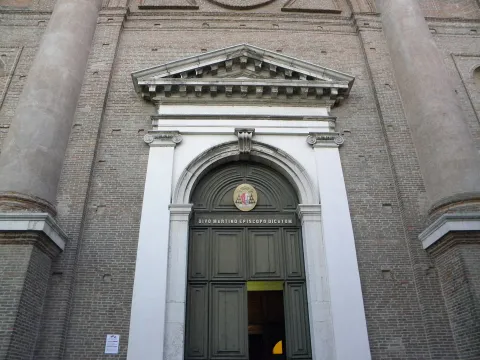
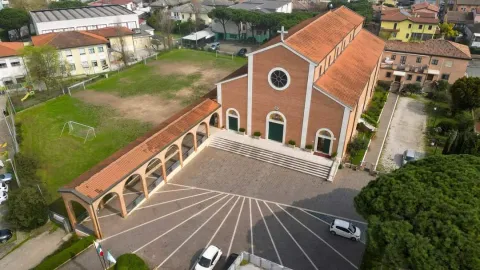
The basilica of San Giacomo Apostolo overlooks the main square of Chioggia and is the second largest church in the old town, after the cathedral. In 1906 Pope Pius X raised it to a minor basilica with the title of the Blessed Virgin of the Navicella: since 15 November 1806 it has kept the relics of the Madonna who, according to tradition, appeared in 1508 on the shore of Sottomarina, brought here from her old sanctuary.
What to see
Before it stood an eleventh-century church, which the historian Pietro Morari, in 1637, described as low and austere, with three naves on brick columns. The present building was begun after the apse collapsed on the night of 24 to 25 November 1741: the following year the design of the Venetian Pietro Pelle was approved, later completed by his nephew Domenico. The interior is rectangular, 25 metres wide, 35 long and 25 high. The ceiling is covered by a fresco of 223 square metres with the martyrdom and glory of Saint James: the martyrdom, below, is by the Vicenza brothers Alessandro and Romualdo Mauri, the ascent to heaven by Antonio Marinetti of Chioggia.
The high altar, designed by Aristide Naccari and made by Pietro Longo in Carrara marble in the early twentieth century, frames the icon and the «zocco», the wooden stump on which, according to tradition, the Madonna sat, protected by silver frames by the goldsmith Giovanni Cristofoli; above is an angel with open arms, in the centre Saint James and at the sides the patron saints Felix and Fortunatus in armour. On the inner façade is the organ by Gaetano Callido of 1793, and near the entrance a large oval canvas of Saint James painted the same year by Giovanni Carlo Bevilacqua. The bell tower was raised at the end of the nineteenth century to a design by Naccari, from just under nineteen metres to thirty-seven and a half, with a weathervane angel on top.
Visiting
The basilica is on the main square of the old town; in front of it is the war memorial with the bronze Winged Victory by Domenico Trentacoste, of 1923. Opening and service times should be checked with the parish.
Our editors' tip
On the north wall look for the «tolèle», nineteenth-century votive panels painted by local artists for those who had received a grace: almost all show boats in shipwreck and fishermen calling on the Madonna della Navicella.