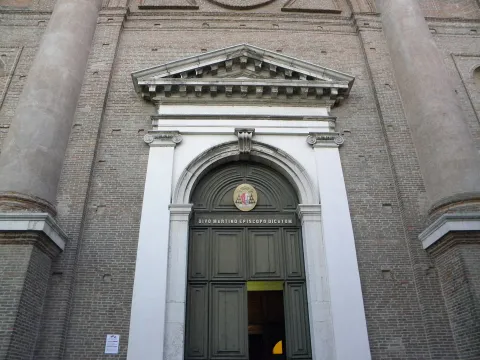
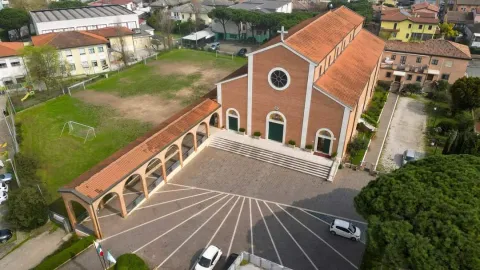
The church of Santa Caterina is in the old town of Chioggia, but unlike the others it does not face the main square: it stands among the houses of the town. For four and a half centuries it was the church of the Cistercian nuns, then of the Canossian sisters. After the War of Chioggia, when Venice forbade building outside the walls, the two Cistercian communities of the island of the Saloni and of Sottomarina joined and moved here; in the second half of the seventeenth century the cloistered nuns numbered 57.
What to see
The church dates from the early fifteenth century but was reworked several times: the most radical intervention was that of Baldassare Longhena in 1660, in the years when he was also working on the cathedral. He also designed the bell tower of 1661, 31 metres high, with an onion dome on an octagonal drum. The toothed wheel, the symbol of Saint Catherine, appears above the portal, in the paving of the churchyard and in the false rose window above the Carrara marble statue of the saint. The interior, 12 metres wide and 13 high, has marble altars in Baroque taste: on that of Saint John the Baptist is a Baptism of Christ by Alvise Benfatto, of 1600, from the former Camaldolese monastery of San Giovanni; the altar of the Madonna della Salute is surrounded by votive offerings for deliverance from the plague of 1631; on the high altar are the Glory of Saint Catherine and a tabernacle of 1680 in polychrome marble.
Between two altars is a Crucifixion with saints by Andrea Vicentino, from the early seventeenth century; near the altar of Saint Lawrence, an eighteenth-century cross in black touchstone inlaid with mother-of-pearl, from the convent of Santa Croce. The wooden pulpit, painted as false marble, bears the saint's symbols in gilded relief: wheel, crown, sword and palm. The organ was installed in 1864 by Giacomo Bazzani and sons, and the sacristy has walnut furniture of 1753.
Visiting
The church is in the old town, away from the square. Opening hours should be checked on site or with the diocese.
Our editors' tip
Ask whether you can go up to the nuns' upper choir, with walnut seats for some sixty sisters: there you will find a Marian cycle by Antonio Zonelli and the Ecstasy of Saint Teresa of Ávila by Antonio Marinetti.