
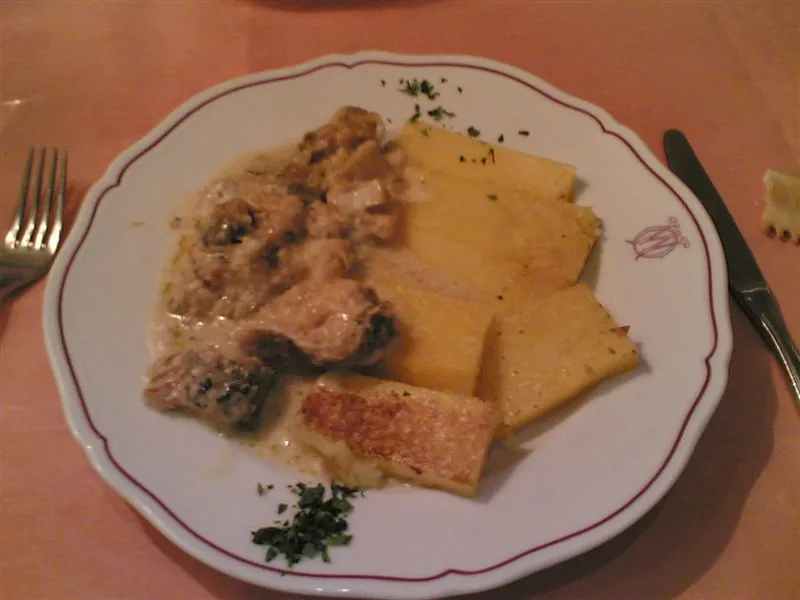
Baccalà alla Vicentina stockfish slow-cooked with milk, oil and anchovies
Stockfish, milk, oil and anchovies, cooked for hours over the lowest heat: baccalà alla vicentina arrived from Norway with a shipwreck in 1432.
Read more →The cliff of Lumignano, looming over the village, is what remains of a coral reef: here the Berici hills once faced a tropical sea, and the limestone that forms them settled in a lagoon whose water lay between twenty-five and twenty-nine degrees, where the barrier divided the inner waters from the open sea that reached as far as the Euganei. In the rock you can still see the remains of corals, hydrozoa and calcareous algae. Rainwater, dissolving that limestone, then hollowed out a dense network of caves and covoli, and at Costozza somebody had an idea: to link them in a system of air ducts that still today brings the cool air from the bowels of the hill, at a constant temperature between twelve and fourteen degrees, into the buildings on the plain. The system was already famous in the fifteen and sixteen hundreds, when it served to cool the noble villas and palaces during the summer heat: an air conditioner four hundred years old.
About the name there is no certainty: it might come from the elongated shape of the territory, squeezed between the Bacchiglione and the hills; or from the medieval Latin longaria, which meant a strip of land emerged from marshy ground, and on old maps the place is indeed Longaria; or from the Longari, that is the Hungarians who raided the plain in the Middle Ages. The first people lived in the covoli — in the cave of Sengio Longo there are palaeolithic traces — and in Roman times the white stone of Costozza won an ever wider market. In 753 a Lombard named Anselmo gave his property at Costozza to the abbey of Nonantola, and that is the act marking the arrival of the Benedictines: around their foundations the land was repopulated and cultivated again. In 1142, during a war among the cities of the March, Padua denied Vicenza the use of the river and land routes; the Vicentines took their revenge by building at Longare a rosta, a barrage that diverted the water into the Bisatto canal and left Padua dry — with no water for its mills, to drink, or to defend itself.
Stockfish, milk, oil and anchovies, cooked for hours over the lowest heat: baccalà alla vicentina arrived from Norway with a shipwreck in 1432.
Read more →Straight-line distances from the town centre. Tap a point to open its page.
The closest destinations covered by our editors, with straight-line distance.
Outside Longare, but an easy day trip away.


