
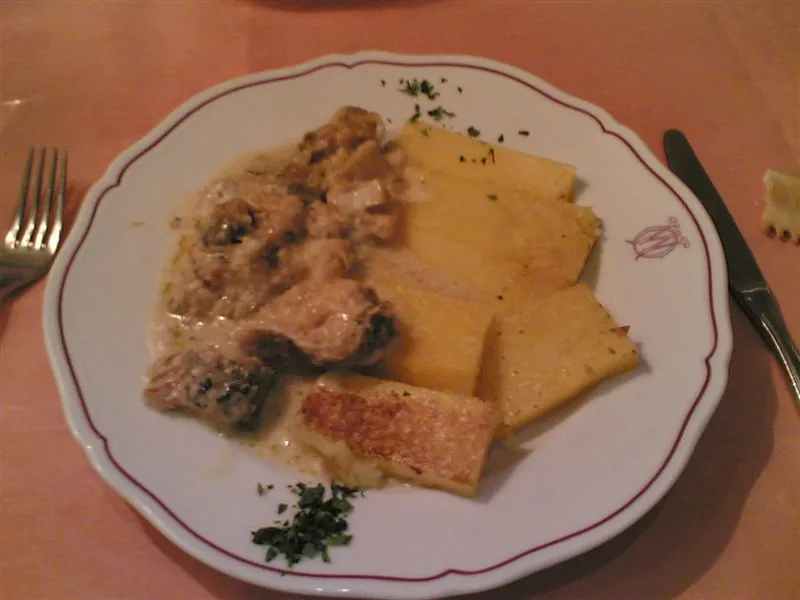
Baccalà alla Vicentina stockfish slow-cooked with milk, oil and anchovies
Stockfish, milk, oil and anchovies, cooked for hours over the lowest heat: baccalà alla vicentina arrived from Norway with a shipwreck in 1432.
Read more →In the arms of the comune there are two temples. The upper one is the temple of Fortuna Virilis in Rome, with the word «Fortunae» on its base, and it is there because the parish church of Castegnero was built on the foundations of a pagan temple dedicated to Fortuna; inside that church there is still a Roman marble stele on which a woman, Satria Procula, dedicated something to the same goddess. The lower temple is Greek, carries the word «Palladium», and stands for the ideal of the comune as a democratic institution. The name may come from the chestnut trees, or from a word for defensive works: there is a via Castellaro here, and a document of 1219 that writes the place Castelniero.
In 1312, when Vicenza passed to the Scaligeri, the fortified post near the bridge over the Bisatto was stormed: the few peasants standing guard were thrown into the canal, and the people took refuge in the covoli, the natural caves of the hills around. Under Venice, Castegnero and Villaganzerla were two separate comuni, governed by their own statutes and their own administrators; in 1816 an imperial decree dissolved the smaller comuni to avoid waste, and Villaganzerla was joined to Castegnero. Two centuries later it was Castegnero's turn: on 21 February 2026 the comune was suppressed and merged with Nanto, and the two together are now called Castegnero Nanto.
Stockfish, milk, oil and anchovies, cooked for hours over the lowest heat: baccalà alla vicentina arrived from Norway with a shipwreck in 1432.
Read more →Straight-line distances from the town centre. Tap a point to open its page.
The closest destinations covered by our editors, with straight-line distance.
Outside Castegnero, but an easy day trip away.


