
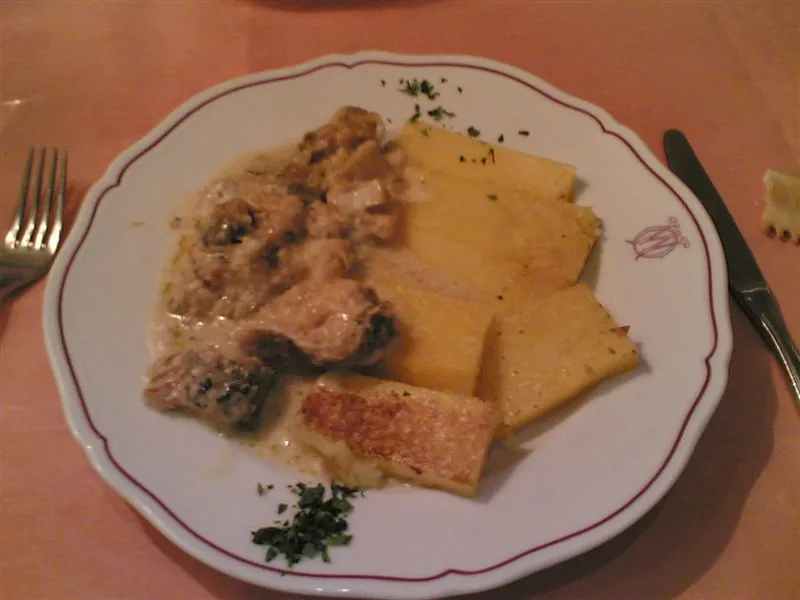
Baccalà alla Vicentina stockfish slow-cooked with milk, oil and anchovies
Stockfish, milk, oil and anchovies, cooked for hours over the lowest heat: baccalà alla vicentina arrived from Norway with a shipwreck in 1432.
Read more →The village belonged for centuries to the Benedictines of the monastery of Santi Felice e Fortunato in Vicenza, and it shows in the name: Saint Vitus is a saint of their devotion, and until 1500 the parish priest was appointed by the abbot. A priory probably existed here before the year one thousand, and a privilege of bishop Rodolfo of 983 alludes to it. The second half of the name comes instead from the mountain above the village, called mons luguzani in the charters of the fourteenth and fifteenth centuries: until 1867 the municipality was simply San Vito. In the thirteenth century German-speaking settlers, the cimbri, were called in to clear the woods and bring the upper land under cultivation.
Of that craft work an organised memory survives: at Corte Priorato there is an ethnographic museum devoted to woodworking, with the ordinary tools of carpentry and the particular ones of cartwrights and coopers, trades documented at San Vito since the early fifteenth century, and with more than two thousand seven hundred objects of daily life. In the church of San Valentino, at Leguzzano, stands a marble altar of 1579 by Bartolomeo Mercante, a local stonecutter. And from San Vito came Amelia Barbieri, midwife and lay missionary, who brought Rwandan orphans to safety during the genocide.
Stockfish, milk, oil and anchovies, cooked for hours over the lowest heat: baccalà alla vicentina arrived from Norway with a shipwreck in 1432.
Read more →Straight-line distances from the town centre. Tap a point to open its page.
The closest destinations covered by our editors, with straight-line distance.
Outside San Vito di Leguzzano, but an easy day trip away.


