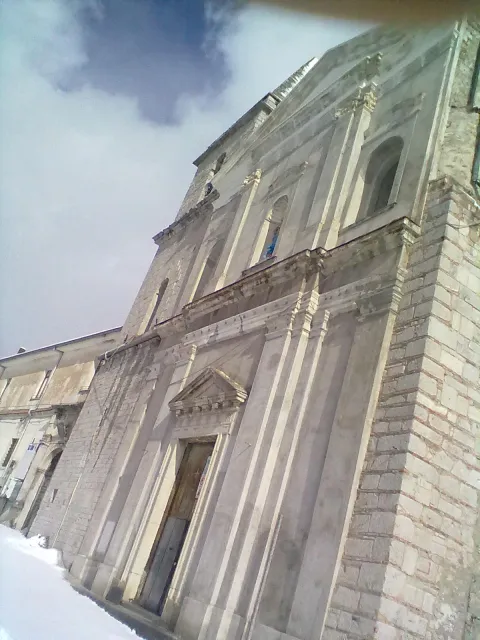
In the documents the building changes its name three times. It is a castellum in the Norman period, when the first written mention of Calvello appears in 1089; it becomes a castrum under Frederick II, who listed it among the twenty-nine castra and domus regie of Basilicata to be kept in repair; and it is already called a palazzo when the Carafa dukes took over from the Sanseverino in the sixteenth century and came to live in it. The first owner whose name we know is one Matheus de Calvello, in 1147: at that time the stronghold was only a quadrangular keep, and that keep is still there, largely intact, surrounded by the buildings that were added to it from the thirteenth century onwards.
What to see
The castle is laid out on three levels and you enter through an arch giving onto the courtyard. On the left, at the first level, runs the loggia that linked the state rooms with the bedrooms; in Carafa times there were only two ways up to the main floor, and the western one was closed by an oversized door. To the right of the arch were the stables, with a stone staircase leading downhill. To the north stretches a long, low, narrow building whose outer perimeter follows a stretch of the old curtain wall.
The rest of the story is written in what is missing. The earthquake of 1273 was the first to leave its mark; the one of 1826 took away the roof and most of the masonry of the top floor; 1857 brought down the second floor; the last tremor was in 1980.
Visiting
The castle stands in the upper part of the town, the lay and feudal pole around which the town arranged itself from the Middle Ages onwards, with the houses climbing in terraces up to the rock. In the mid-twentieth century it was sold to several owners and split into private flats, so it is not a museum with a ticket desk and opening hours: what you look at from outside is the keep, the courtyard front and the surviving stretch of wall. Recent consolidation and restoration work has made the structure safe again.
Our editors' tip
Stop in the courtyard and think about the Carbonari risings of 1820-21: the court martial that passed summary judgement on the Calvello insurgents, led by the town doctor Carlo Mazziotta, sat right here. It is probably the heaviest episode in the history of the town, and it happened inside these walls rather than out in the square. Then walk down towards the river, as far as the Sant'Antuono bridge: from there you see the whole climb of houses in one go, castle on top.