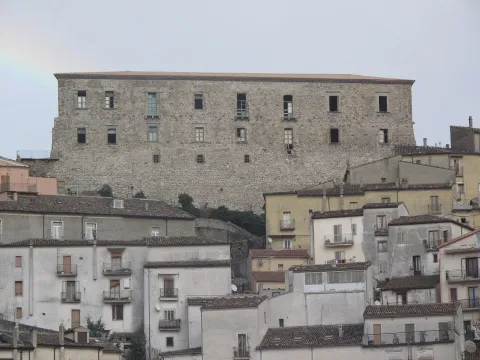
Calvello has had two centres of gravity for almost a thousand years: the castle above, lay and feudal, and below, on the flat ground, the complex of Santa Maria de Plano. The first document naming the town dates from 1089, when Normanno, eleventh count of Marsico, gave two local churches to the abbot of Santo Stefano at Marsico Nuovo; the priory of Santa Maria de Plano was founded around the middle of the twelfth century by the Benedictines of that same Marsico Nuovo, on which it depended, and the church is first recorded in 1145. The convent with its cloister came much later: the Franciscans built it at the end of the sixteenth century, in all likelihood over the remains of an earlier structure.
What to see
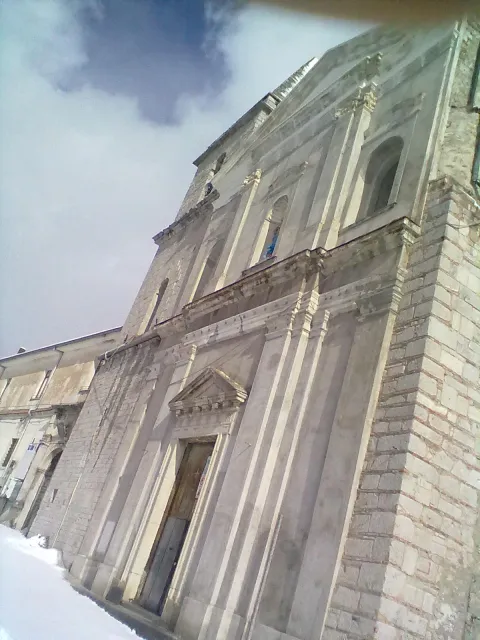
The church is basilican in plan, with three naves divided by square-section pillars. Outside, what counts most are the two Romanesque portals, one on the main façade and one on the north side: their capitals and architectural layout echo the portal of the church of San Michele at Marsico Nuovo, attributed to the stonecutter and architect Melchiorre da Montalbano, that is, the mother house the priory depended on.
Inside, the piece to look for is the gilded wooden statue of the Madonna and Child. In the cloister it is the frescoes of the seventeenth and eighteenth centuries: they are not confined to the walls but run across the vaults as well, so you have to look up.
Visiting
The complex lies downhill from the built-up area, at the opposite end from the castle, and it pays to start outside: the two portals resemble each other without being identical, and comparing them before you go in is the best way to notice it. The church itself is quickly walked; the cloister deserves time.
Our editors' tip
Take the name de Plano with you, because you will meet it again higher up. Of the old copy of the Byzantine statue of the Madonna de Plano only fragments remain, gathered after the earthquake of 1857 and put back together by a Neapolitan artist: they form the effigy venerated in the sanctuary of Monte Saraceno, 1320 metres above the village, where it is carried in procession on the second Sunday of May.