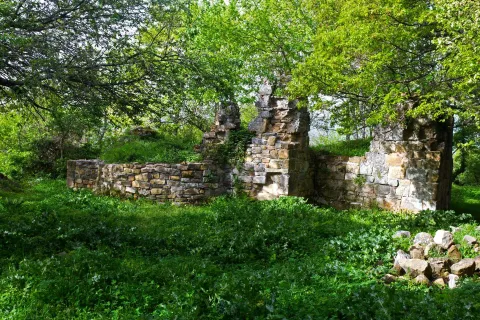
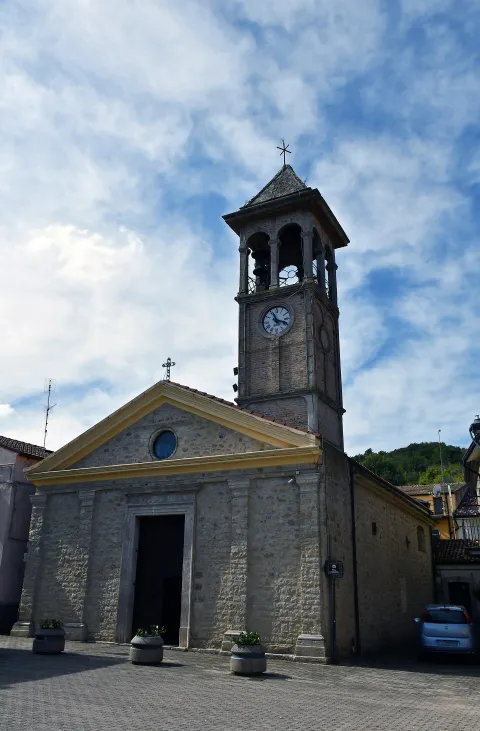
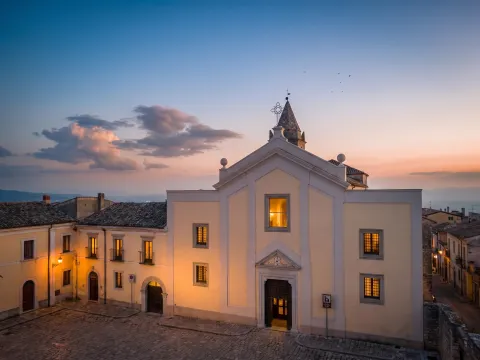
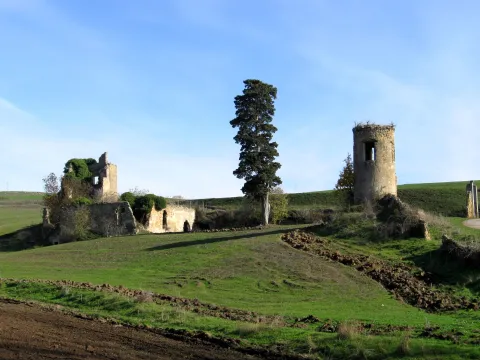
The name people in Filiano use, Tuppo dei Sassi, comes from a mistake: the shelter stands at Serra Pisconi, not at the Tuppo, and in 1965 it was formally renamed after Professor Francesco Ranaldi, the archaeologist who between 1962 and 1964 proved its scientific interest. Local shepherds had always known about it; it was a resident, Francesco Verrastro, who pushed Ranaldi to go and look at the wall. In September 1966 news of the rock paintings reached the “London News”.
What to see
The shelter is a half-vault of sandstone about 6 metres high, at 800 metres above sea level, inside the I Pisconi anthropological nature reserve. The red ochre figures crowd almost entirely into a rectangle 65 centimetres tall and 52 wide, on the smoothest stretch of wall: human bodies cut back to head, arms and legs, and four-legged animals in profile with their muzzles turned left. Some carry branching segments above the head, which read as antlers; others, lacking them, may be dogs. Everything was drawn with the fingers, in a schematic style that reduces the shapes to their essential lines.
What they mean is still argued over. Biancofiore in 1965 saw a hunt dominated by the large human figure at the top right; Ranaldi saw men holding animals on ropes under the eye of a deity; Borzatti and Inglis in 1990 read a wood full of deer, painted in two separate phases; Affuso in 2012 a mother goddess; Arcà and Bozzarelli in 2018 five deer and a many-lobed figure in a broad-brimmed hat. The dating stays Mesolithic, though the Copper Age has also been proposed for the human figures. The 1971 dig, a trench 4 metres deep halted by fallen boulders, produced about 300 flint tools and flakes and not a single bone: the acid soil dissolved them.
Visiting
The site is in contrada Carpini, at the end of a nature trail fitted with walkways and panels on the plants and animals of the reserve, and it is closed by a gate: entry is by booking only, with guiding run by the town council of Filiano and the Protezione Civile. The reserve, established in 1972, is open for educational and study purposes, not as a free walk.
Our editors' tip
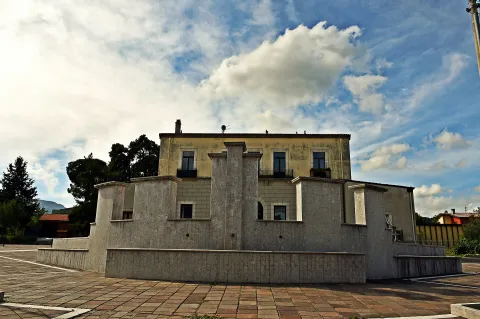
Call first at the multimedia museum opened in contrada Carpini in August 2019: it holds a full-size reproduction of the painted panel. Having seen it will help you pick out the faintest motifs on the real wall, which otherwise vanish into the calcareous film.