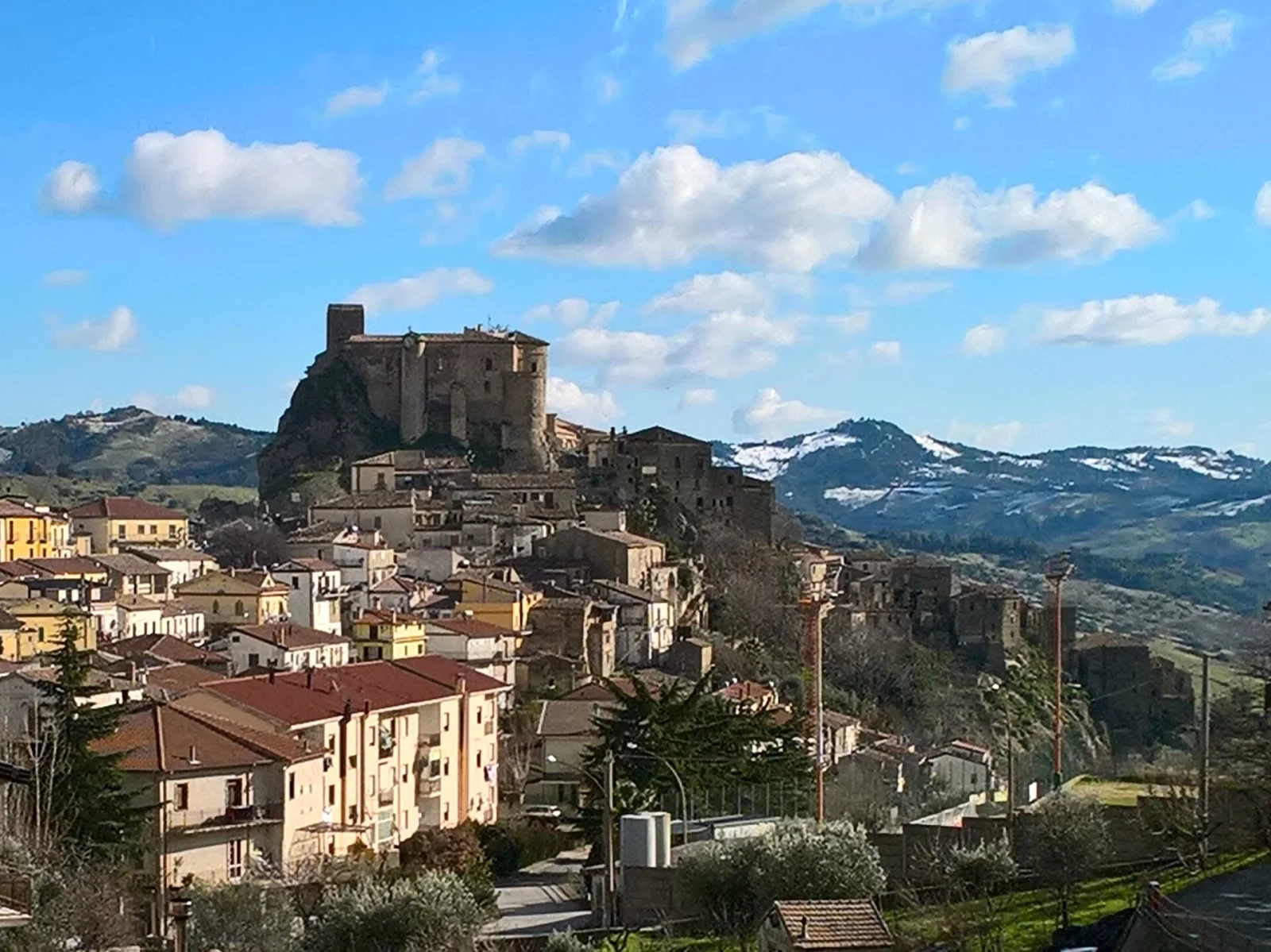
The village was born as a fortress for those who had fled the coast before the Saracen raids: a historian of Oriolo, writing in 1695, tells that those people withdrew under the rock, settled in the contrada Ravita and then built houses of several storeys, which they ringed with battlemented walls. Its name can be watched changing shape in the documents: in Byzantine Greek it is the kastron Ourtzoulon, then Ourzoulon in 1117, Ortzoulon in 1131, Orgilon in 1132, Orghiolon in 1186, and at last, in a donation of Frederick II of 1221, the Latin Ordeolum. Gerhard Rohlfs traced it back to hordeolus, the grain of barley. By the year one thousand Oriolo was already a civitas with a notary of its own: an act of 1015 closes with the words signed by me Leone, notary of the city of Oriolo.
In September 1117 Mabilia, countess of Oriolo, gave the abbey of Cava a church with its farms; in 1129 king Roger besieged the place and took it; and on the twenty-fourth of April 1221 Frederick II gave a great forest of this territory to the Cistercians of Santa Maria del Sagittario — in 1679, more than four centuries later, citizens of Oriolo were still paying the ground rent for those lands to the abbey's commendatory. In 1246 the fief was held by Ruggero De Amicis, one of the highest officials of the kingdom and at the last Gran Giustiziere: he exchanged verses and ballads with Rinaldo d'Aquino and belongs to the Sicilian School of poetry, and he took part in the conspiracy against that same Frederick II who had given the forest. The plot was discovered, his goods confiscated, and only after his death was his son reinstated in the barony. The Angevin registers of 1276 count one thousand and twenty-five inhabitants.