Basilica santuario di Santa Maria di Pozzano
Basilica and shrine on the hill of Pozzano, home of the Madonna venerated as the city's co-patron.
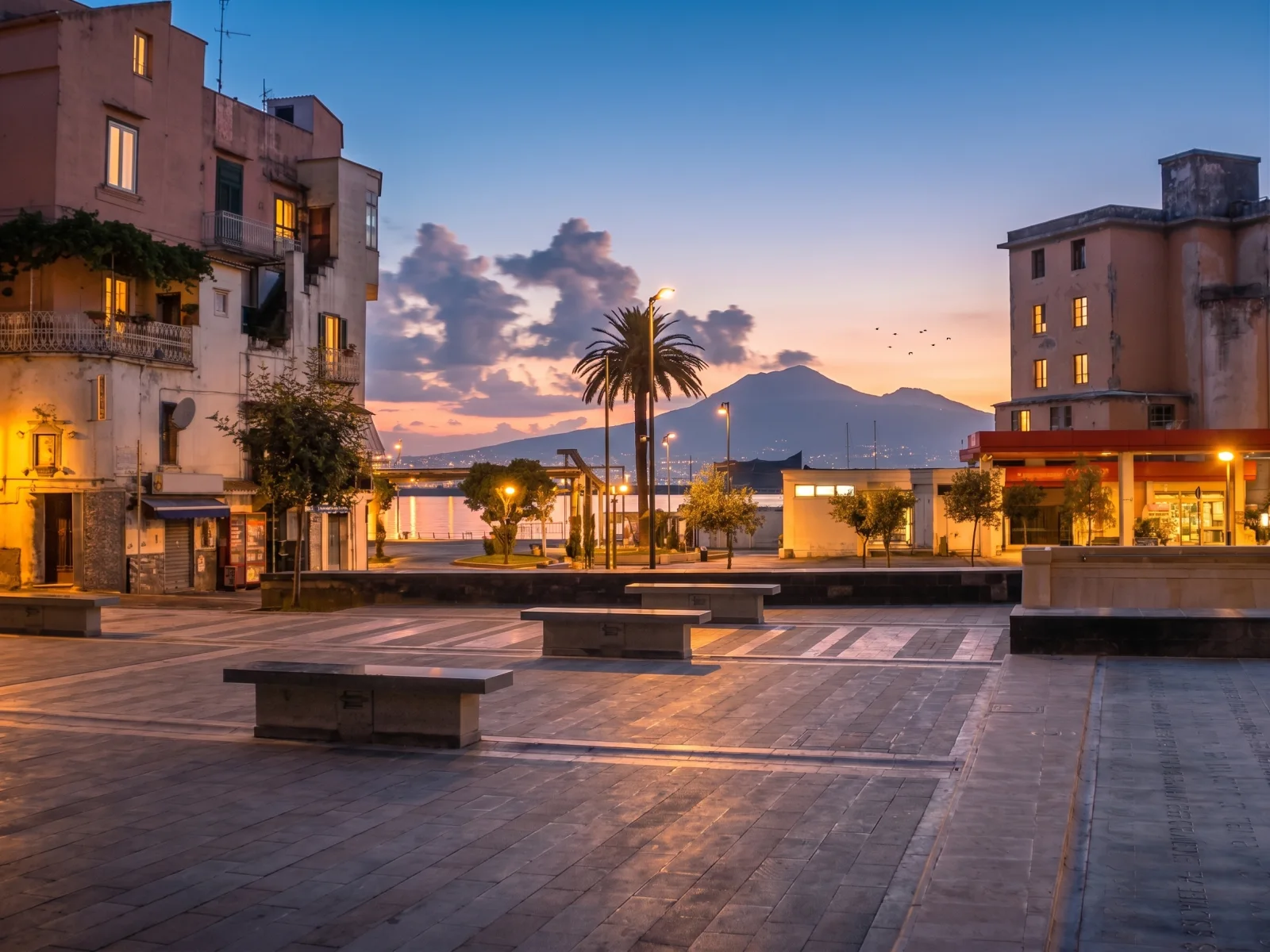
4 places covered in Castellammare di Stabia
No place with that name: try fewer letters.
Basilica and shrine on the hill of Pozzano, home of the Madonna venerated as the city's co-patron.
Seventeenth-century Jesuit church in Castellammare, with Luca Giordano's Virgin of Succour.
Shrine at Scanzano, consecrated in 1908, holding the remains of Blessed Maria Maddalena Starace.
Hill shrine at Quisisana born in 1717 around a fresco of the Madonna, reopened in 1991.
The Arch of San Catello is a monument in Castellammare di Stabia, on the site of an old city gate. From the arch, a remnant of the old walls, a powerful statue of the saint, co-patron of the city, looks down.
On the site of the arch stood, from the fourteenth century, one of the city gates, the porta del Quartuccio. This gate, together with the defensive wall, was partly demolished, as it was no longer needed, around 1790. In 1819 Vincenzo Vingiani asked for the definitive demolition of the remaining arch, in order to enlarge his palace, but Saverio Scelzo, first owner of the adjoining palace later called Martingano, strenuously opposed it and obtained the personal intervention of the Intendant of the Province, who blocked the project.
So a masonry arch remained, on which, after a request of 1840 by Gaetano Martingano, owner of the adjacent building, the statue of Saint Catello was placed. In 1995 the area was restored and the town administration put up a plaque, composed by Professor Pippo D'Angelo.
The arch is in Castellammare di Stabia, on the site of the porta del Quartuccio, beside the palace known as Martingano. The sources consulted give neither the street nor other visiting arrangements: check them on the spot.
The plaque of 1995 recalls that here stood the old sea gate of the Quartuccio, of the fourteenth century, where all carts entering the city paid the Quartuccio toll; it says that it was partly demolished around 1790 and then rebuilt at the town's expense in 1819.
The grotto of San Biagio, also called the hypogeum of Saints Jason and Maurus, is a tuff cavity in Castellammare di Stabia that was an early Christian cemetery, a Benedictine oratory and a Catholic church, perhaps after being a pagan temple; it preserves a cycle of frescoes in Byzantine and Lombard style.
To build the Roman villas of ancient Stabiae, tuff was probably quarried from the foot of the hill of Varano, forming five cavities; one of these, later called the grotto of San Biagio, already had another role in Roman times. According to the seventeenth-century patrician Rosania it was a temple of Pluto with an oracle, but there is no firm evidence; it is nonetheless possible that it was a pagan temple, since with the arrival of the Benedictines such places were often consecrated to Saint Michael. Between the fifth and seventh centuries it became an early Christian cemetery, perhaps of a noble family with a villa in the territory of Stabiae, and a first painting cycle was carried out there. With the arrival of the Benedictines, between the sixth and eighth centuries, it was turned into an oratory with the cult of Saint Michael; a French monk, Bernard, returning in 870 from a journey to the Holy Land, visited the grotto, describing it as so deep and dark that torches were needed. Between the tenth and eleventh centuries it was reinforced with arches, the side galleries were closed and a new painting cycle was carried out; between the eleventh and twelfth centuries, according to Monsignor Francesco Di Capua, it was consecrated to Saints Jason and Maurus, brothers martyred in the third century, and became a destination for processions. The name Jason was no longer used and was mistakenly read as Blaise; in the seventeenth century the grotto was entrusted to the wool carders, who had Saint Blaise as their protector. A popular belief held it to be the place of a hidden treasure: the structures, the frescoes and the tombs were defaced and in 1695 Bishop Annibale di Pietropaolo had it closed. In the nineteenth century it was used as a gunpowder store; the first systematic investigations, in 1950, were by Libero D'Orsi, who found Christian burials covered with Roman and early Christian tiles.
The grotto is at the foot of the hill of Varano, beneath the Roman villa known as Arianna; in antiquity it faced the road that linked Stabiae to Nuceria. An engraving of 1750 by Pio Tommaso Milante shows it as it must have looked in the mid eighteenth century: barrel vault, altar at the end, three altars on each side, an arched entrance and a seat, all in opus reticulatum. Today it lies five metres below street level, is thirty-three metres long and three wide and is divided into atrium, nave and apse; the atrium, supported by tuff arches, has small niches in the walls, perhaps for lamps or funerary objects, and traces of frescoes in Giotto's style with Franciscan themes.
The grotto of San Biagio is at the foot of the hill of Varano, in Castellammare di Stabia, beneath the Roman villa known as Arianna. The sources consulted give no opening hours or visiting arrangements: check them.
In 2007, during cleaning work, fragments of a statue, perhaps of Saint Blaise, were found, later reassembled and shown in the Museo diocesano sorrentino-stabiese; in 1970 four more grottoes were identified outside, never explored and walled up with cement.
Skip the line and see the best with a guide: hand-picked tickets and tours.
Some links may earn BigItalia a commission, at no extra cost to you.
Pizza Napoletana · Caprese
Compare hotels, B&Bs and holiday homes on Booking.com for your dates.
Next up: Saint Catellus, the 7th-century bishop who patronises Castellammare di Stabia, Tuesday 19 January
Nearest airport: Napoli Capodichino, 27 km away
The closest destinations covered by our editors, with straight-line distance.


