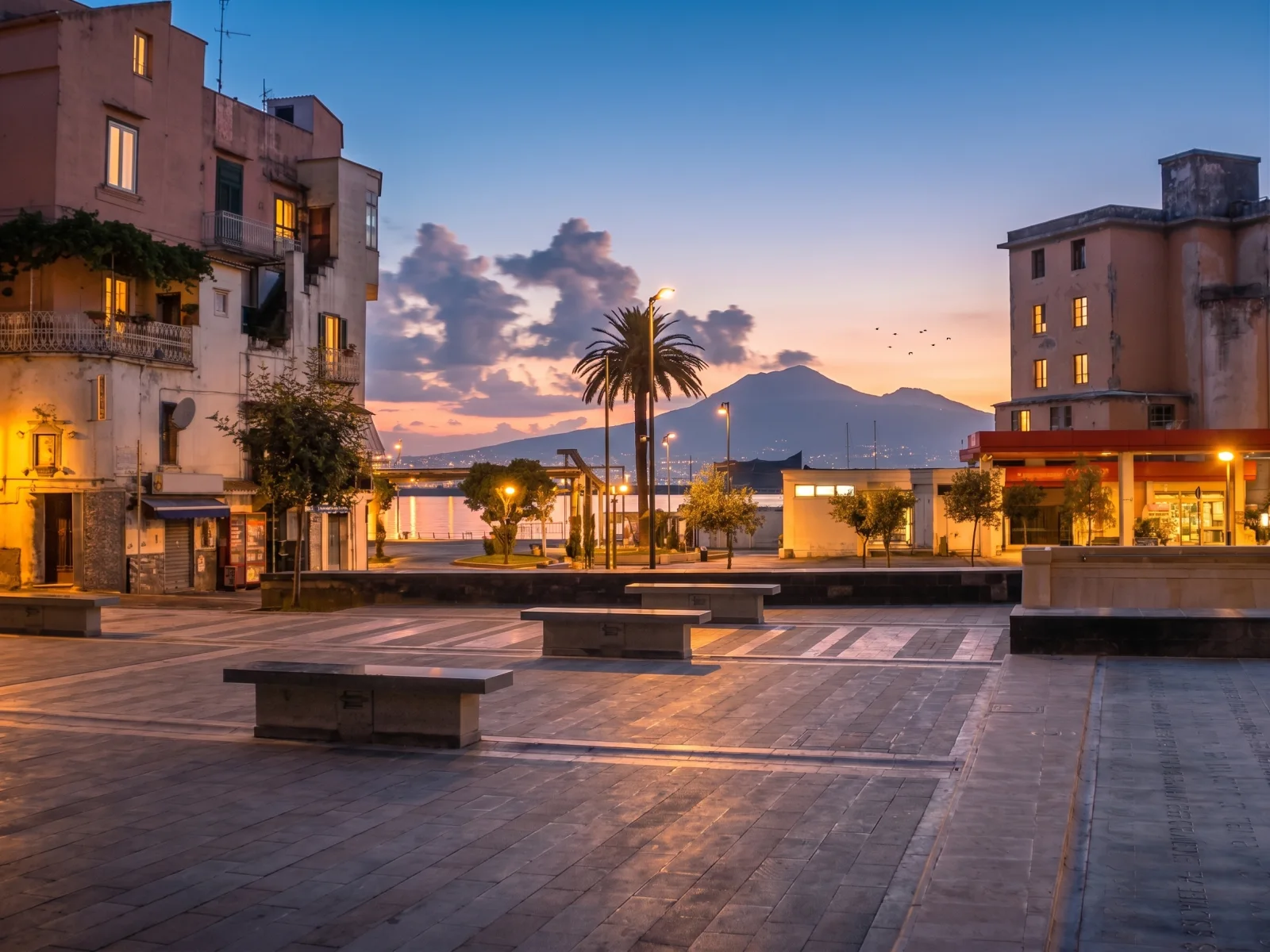
The church of Gesù e Maria is a monumental church in the historic centre of Castellammare di Stabia, belonging to the parish of the co-cathedral of Santissima Maria Assunta and San Catello.
What to see
On 9 April 1608 the town council and Bishop Ippolito Riva invited the Jesuits to the town, entrusting them with founding a church with an attached college and supporting them with about three hundred ducats a year; the agreement was concluded on 26 August 1609. A townsman, Pier Giovanni Nocera, gave a strong boost with a contribution to the building and, according to the notarial deed, chose the name of the complex, Santa Maria del Soccorso. The Jesuits, viewed with suspicion by the other orders, arrived on 24 December 1609; the work, to designs by Pietro Provedi and then Agazio Stoia, began in 1614 and was finished the year after. After the Jesuits were expelled from the Kingdom of Naples in 1767, the church passed to the town and in 1786 to the Comunità del Clero, priests of Stabia with Saint Philip Neri as protector, which over about fifty years changed its appearance: a new organ, fine marbles for the high altar, a new sacristy, a new wooden choir, and the façade and stuccoes redone. On 19 November 1839 Bishop Angelo Maria Scanzano consecrated it again for the end of the works and the name became the present Gesù e Maria; at the end of the twentieth century the church had a complete restoration.
The church is a single nave with a barrel vault, the high altar in an apse and four side chapels, two on each side, lit by seven large windows. The façade has two sections divided by an entablature, with pilasters in the lower part, the portal protected by an iron gate and, above, the emblem of the town and of the Clergy by Giuseppe Filosa, made between 1839 and 1841; it ends in a triangular pediment and has, on the right, two small bell cells, because the church has no bell tower. Over the entrance is an oil on canvas by Paolo De Matteis showing Saint Ignatius and Saint Francis Xavier receiving from the pope the brief for their mission; on either side of the high altar are two choir galleries, redone in 1790 by Prince Urbano Barberini, who was able to link one to his own palace by a covered bridge. The high altar and the balustrade have marbles that the congregation bought in 1812 from the old church of the Annunziata at Angri, and on the altar is the Beata Vergine del Rifugio or del Soccorso, by Luca Giordano. The vault has the Glory of Christ by Vincenzo Galloppi, completed on 16 July 1899 in place of an earlier fresco by Filippo Andreoli, and the apse, completed on 1 January 1895, has in the lunette the Sermon on the Mount, by Galloppi again.
Visiting
The church is in the historic centre of Castellammare di Stabia; according to other sources on Strada Gesù, number 11. The sources consulted give no opening hours or visiting arrangements: check them.
Our editors' tip
According to other sources there are also six eighteenth-century canvases of angels by Angelo Mozzillo and a processional festival float used for the feast of the Holy Sacrament.