When the Bourbons excavated it between 1764 and 1766 it was the best preserved temple in Pompeii, and half of Europe came to see it: an intact Egyptian sanctuary, with colours on the walls, the cult objects still in place and the ashes of the last sacrifice on the altar. Among the visitors was a boy of fourteen, Wolfgang Amadeus Mozart, and anyone who knows the Magic Flute recognises the setting here. The temple was of the second century BC; the earthquake of 62 destroyed it and Numerius Popidius Ampliatus rebuilt it, a rich freedman, putting the work in the name of his six-year-old son Celsinus so the child would enter the city council: the inscription on the door says so without embarrassment.
What to see
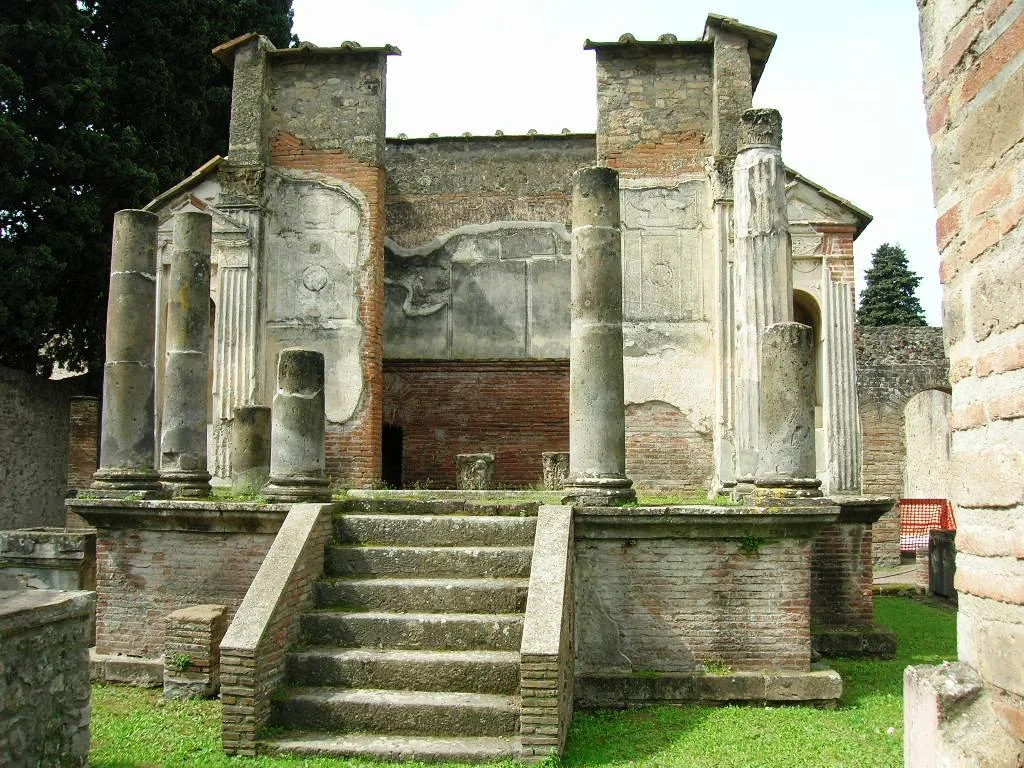
The porticoed courtyard with the cella at its centre, raised on a podium reached by a staircase: inside was the bench with the statues of Isis and Osiris, and behind a niche with a Dionysus. To the left of the steps, the main altar, where the burnt bones of the sacrifices were found. In the corner, the purgatorium, the small sunken shrine that held the sacred water, brought from the Nile or passed off as such, with blue and yellow stucco and figures of priests in procession.
Then the rooms around: the ekklesiasterion, where the community met and feasted, with a black and white mosaic floor; the sacrarium, where the vestments were kept, with the Apis bull and Osiris enthroned painted on white; the priests' apartment, the kitchen, the dining room. The paintings were all detached in the eighteenth century and are in the Archaeological Museum of Naples, which has devoted a room to them: Nile landscapes, crocodiles, ibises, priestesses, and the myth of Io. Here remain the walls, the podium and the exact shape of an eastern cult in an Italian town.
Visiting
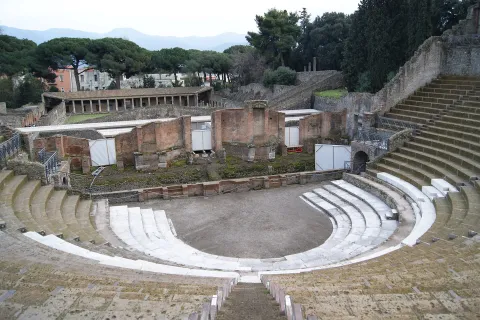
The temple is in the theatre district, near the large theatre and the Samnite palaestra, ten minutes from the Porta Marina entrance; it is included in the excavations ticket, with the park's hours. A quarter of an hour. To understand it properly you also need to see the Isiac room in the Naples museum, where the frescoes and objects ended up.
Our editors' tip
Read the inscription, or its translation on the panel: a father who rebuilds a temple at his own expense and puts it in the name of a six-year-old to buy him a political career is the most contemporary thing Pompeii has to say. Then go down into the purgatorium and stand a minute in the cool: the Nile water was the reason people came here.