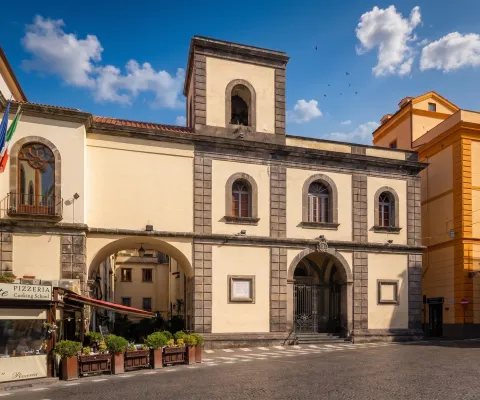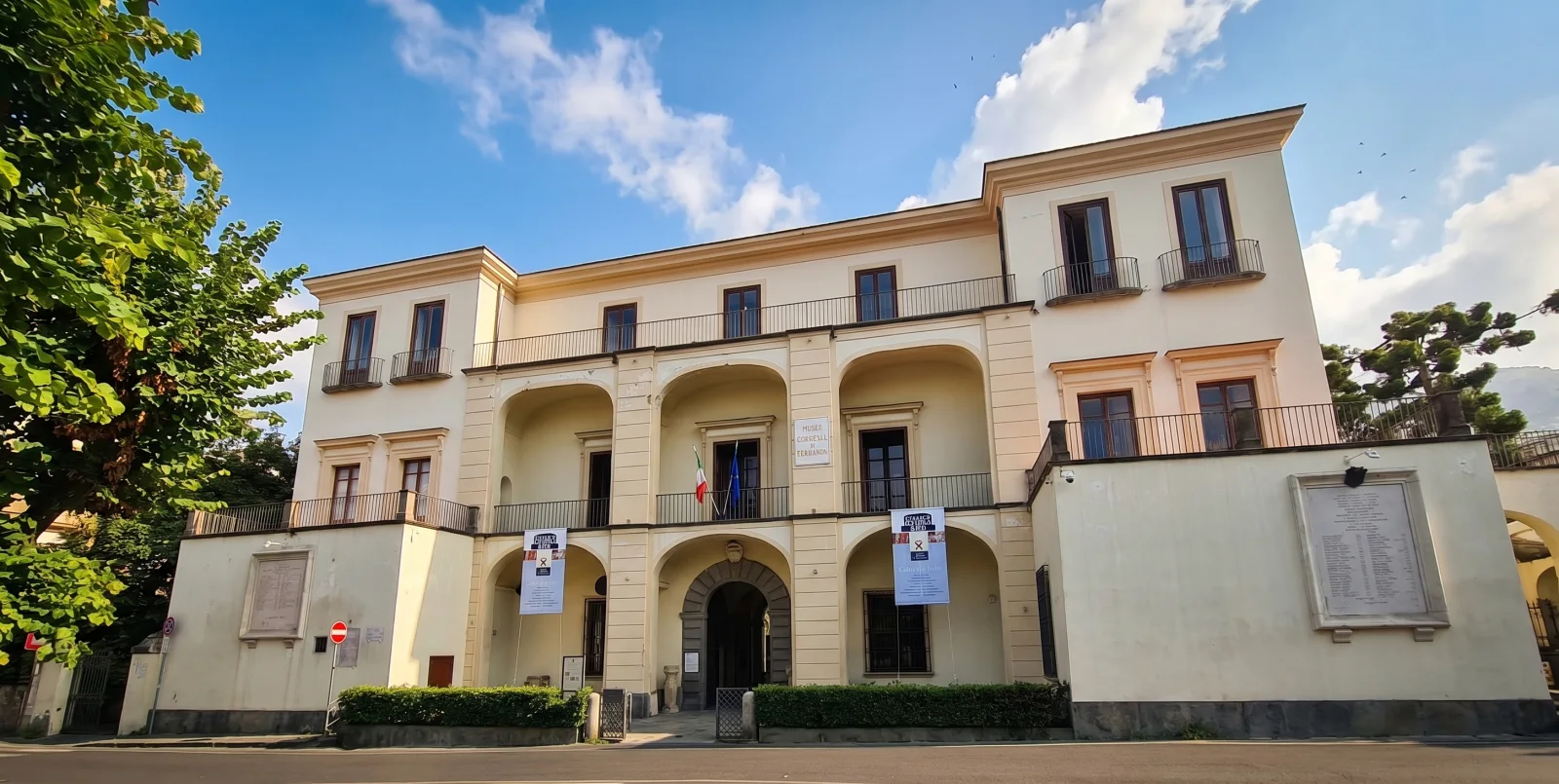
Brothers Pompeo and Alfredo Correale, the last counts of Terranova, stipulated in their will that their family's heritage of art should remain intact inside their Sorrento summer home. Established in 1902 and officially opened in 1924, the museum endured decades of closure due to legal disputes before permanently reopening in 1989. The institution occupies Villa Correale, an 18th-century residence also called Villa della Rota, defined by a rectangular footprint, a central façade featuring two tiers of arches, and a grand portal topped with the Correale coat of arms.
What to see
The layout spans twenty-four rooms across three main floors, connected by an 18th-century grand staircase designed by engineer Giovan Battista Nauclerio with dark piperno stone balustrades. On the ground floor, visitors enter the founders' hall displaying portraits of the counts and a 19th-century genealogy tree. Subsequent rooms showcase Sorrento's famed wood-inlay craftsmanship, including fine tarsia furniture donated in 1937 by Silvio Salvatore Gargiulo and a 1910 multi-purpose writing desk by Giuseppe Gargiulo. The archaeological section presents prehistoric bronze tools, Attic pottery, medieval reliefs saved from Sorrento's former cathedral, and an Imperial Roman marble altar commemorating the opening of the Temple of Vesta on the Palatine Hill. The ground floor also houses a library founded in 1918, holding six thousand printed works, four hundred manuscripts, and the death mask of poet Torquato Tasso.
The upper levels contain the art collections. The first floor displays Mannerist and Baroque paintings by Artemisia Gentileschi, Andrea Vaccaro, Salvator Rosa, Francesco De Mura, and Battistello Caracciolo, alongside Flemish canvases by Peter Paul Rubens and Frans Vervloet. The second floor features still lifes by Giovan Battista Ruoppolo and Tommaso Realfonso, 19th-century landscapes by School of Posillipo painters Giacinto Gigante and Antonie Sminck Pitloo, as well as a gallery of 18th-century European clocks, silver, and Murano crystal. The third floor holds fine porcelain and majolica from Capodimonte, Meissen, Sèvres, Vienna, and Castelli.
Visiting
The attic area of the villa is routinely used for temporary cultural exhibitions. Outside, the property features a garden planted with a citrus orchard, a grove of Camellia japonica, an Araucaria excelsa, and a tropical Ceiba speciosa. A tree-lined avenue of plane trees leads straight to a belvedere terrace looking out over the Gulf of Naples.
Our editors' tip
Do not bypass the archaeological room on the ground floor: the Roman marble altar of Vesta is the single most historic ancient relic recovered on the Sorrento peninsula.