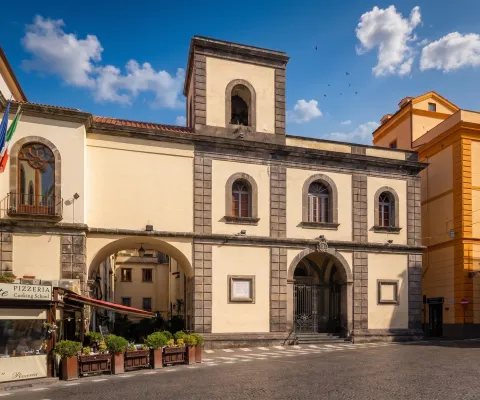
Between 230 and 240 AD, an early Christian sanctuary was erected on the site of a pagan temple where Sorrento locals Marco, Quartilla, Quintino, Quintilla, and nine others were executed under Diocletian's rule. In the 16th century, Bishop Lelio Brancaccio entrusted the church to Carmelite friars from Naples, leading prior Bartolomeo Pasca to build a new church and monastery completed in 1572. Restored in the Baroque style during the 18th century, the complex was seized during the Napoleonic era, transferred to the Sorrento municipality in 1816, and became part of the active town center in 1866 when the Vallone dei Mulini was filled to create a new public square.
What to see
The three-tiered Baroque facade features stucco work, pilasters, and a central arch that conceals architectural traces of Roman columns uncovered during restoration. Entrance to the single-nave interior is made through a narthex featuring two piperno stone portals, the sole surviving elements from the earlier church structure. The ceiling is dominated by a 1710 canvas by Onofrio Avellino depicting the Virgin presenting the scapular to Saint Simon among Carmelite saints and angels. Above the vestibule, the organ installed in 1975 contains over seven hundred pipes. The right wall houses stucco niches, sepulchral inscriptions for benefactors Nicola Falangola and Patrizio Sorrentino, and two chapels with 18th-century canvasses portraying the Beatification of Saint Teresa of Avila and Saint Mary Magdalene with Saint Andrew Corsini. On the left side stand a 17th-century reliquary and artworks depicting Saint Francis of Paola and the Virgin at the foot of the cross. The main altar centers on the 16th-century Madonna Bruna, painted on two poplar panels by Silvestro Bruno and framed in gold; it is flanked by two 1758 works by Giovanni Cingeri depicting the Adoration of the Magi and the Adoration of the Shepherds, as well as a 16th-century carved marble panel marking Bartolomeo Pasca's tomb. To the left of the high altar lies the chapel dedicated to Sorrento's early martyrs, centered on an anonymous 17th-century painting of their execution.
Visiting
Visitors enter through the vestibule, passing two holy water stoups bearing the Falangola coat of arms before reaching the nave. The main devotional focus remains the sanctuary's apse housing the Madonna Bruna and the dedicated chapel honoring Sorrento's early Christian martyrs.
Our editors' tip
Pay close attention to the narthex when entering: the two square-headed piperno portals and the Roman column fragments in the facade's lower arch offer tangible proof of the site's ancient origins prior to its 18th-century Baroque rebuilding.