Consecrated on March 16, 1113, by Cardinal Riccardo de Albano over the remains of an ancient Greek temple, the Cathedral of Saints Philip and James is the mother church of the Archdiocese of Sorrento-Castellammare di Stabia. Completely rebuilt in 1573 following an Ottoman raid in 1558, and updated to the Baroque style in the early 18th century under Bishops Didaco Petra and Filippo Anastasio, the church received its current Neogothic façade in 1924 after a severe tornado damaged the building.
What to see
The 1924 façade is split into two tiers by an entablature. Its 16th-century central portal incorporates two pink marble columns taken from ancient pagan temples, set beneath frescoed lunettes representing the Assumption and Saints Philip and James. Inside, the Latin-cross layout features three aisles separated by fourteen piers. The flat ceiling holds Baroque canvases by Francesco Francareccio and Oronzo and Nicola Malinconico portraying 2nd-century local martyrs, while above the entrance stands a carved organ crafted in 1901 by the Fiorentino brothers. In the presbytery, ceiling canvases painted by Giacomo del Pò in 1700 overlook a 17th-century altarpiece and a 1938 choir stall made from Caucasian walnut by local craftsmen. The overhead dome was painted in 1902 by Pietro Barone and Augusto Moriani.
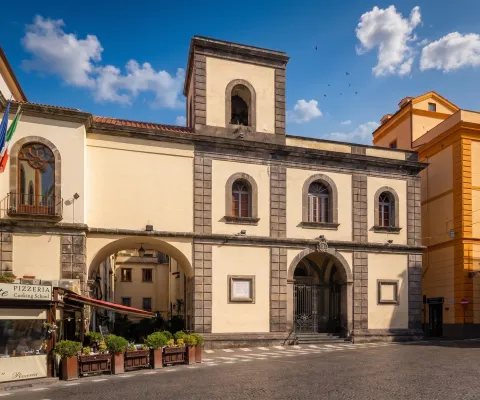
Along the right aisle, a chapel houses marble bas-reliefs by Andrea Pisano alongside the baptismal font where poet Torquato Tasso was baptized in 1544. Nearby, a side door dated to 1479 bears the coats of arms of Pope Sixtus IV and King Ferrante of Aragon. The left side includes a chapel with a 17th-century Neapolitan nativity scene, the 1608 sacristy, and transept chapels dedicated to Saint Antoninus and the Reconciliation. Notable liturgical fittings include an episcopal throne constructed from Roman and 16th-century marbles, a 16th-century pulpit displaying a relief of Christ's baptism over a 1573 altarpiece by Salvatore Buono, a 10th-century marble tombstone carved with a lioness, and an inlaid wooden entrance screen designed in 1989 by Vincenzo Stinga and executed by Giuseppe Rocco. Standing roughly 50 meters apart from the church, the bell tower features an 11th-century Romanesque base surmounted by four stories and a ceramic-tiled clock.
Visiting
The cathedral interior allows access to the 1608 sacristy, which displays historical vestments, portraits of former bishops, and a painting of the Transfiguration donated by Archdeacon Giovanni Ammone. The detached bell tower can be viewed from the adjacent street, showcasing its original Romanesque foundation.
Our editors' tip
In the right aisle, make sure to inspect the Renaissance baptismal font used for Torquato Tasso in 1544, and compare the traditional Sorrento wood inlay techniques seen on the 1938 presbytery choir with the contemporary paneling created for the entrance screen in 1989.