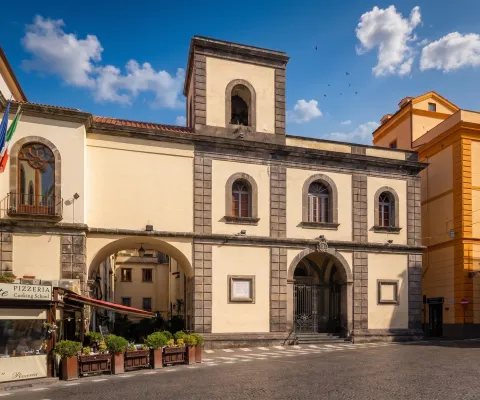
Before transferring its seat to the Church of Saints Philip and James in the 15th century, the Church of Saints Felix and Baccolo—also known as the Church of the Rosary—served as Sorrento's cathedral for nearly three centuries. Built over a Roman temple dedicated to Jupiter or all gods, its founding date remains uncertain, attributed either to Emperor Constantine I in 310 or to Duke Sergio of Sorrento in the 12th century to drive away local demons. Consecrated to Saint Felix of Nola and Saint Baccolo, a former bishop and patron of the city, the building became home to the noble congregation of the Souls of Purgatory in 1651 before being entrusted to the Confraternity of the Holy Rosary in 1834.
What to see
The Baroque façade, reshaped during 17th-century renovations, is divided into two tiers by an entablature. The lower section presents a main portal set between pilasters and decorated with geometric stuccos, while the upper level contains a central niche holding a statue of Saint Baccolo between two rectangular windows, topped by a pediment with an iron cross. Inside, the single nave is entirely clad in polychrome marble beneath a coffered ceiling with a central painting depicting the Holy Trinity. The 18th-century high altar, created by Antonio Gandolfo, features sculpted angel heads surrounding the Holy Spirit above the tabernacle, with an urn holding the relics of Saint Baccolo beneath it and a statue of the Virgin of the Rosary above. The right chapel contains an altar and organ transferred from the church of San Vincenzo, along with a 16th-century painting showing Saint Dominic, Saint Rose, and other Dominican saints receiving the rosary from the Virgin, surrounded by the fifteen mysteries. The left chapel, historically linked to the Donnorso family, houses a panel depicting Saint Joseph, Saint Januarius, and Saint Raphael centered around a Byzantine icon of the Virgin and Child. Additional works include a 1734 painting of Saint Baccolo by Giovanni Bernardo, statues of Saint Joseph, Saint Irene, Saint Louis, Saint Michael, and Saint Baccolo, as well as an 18th-century Neapolitan nativity scene.
Visiting
Visitors can view the crypt dating to 1753, decorated with a painting of the Madonna and Child and filled with ex-voto offerings. The church underwent restoration in the late 20th century to fix structural damage caused by the 1980 Irpinia earthquake.
Our editors' tip
Inside the left chapel, look closely at the central panel painting to see how a small Byzantine icon of the Virgin and Child was integrated directly into the middle of the artwork alongside Saint Joseph, Saint Januarius, and Saint Raphael.